HomeJesus ChristCross to ascension
Sources & method

Source basis: Gospel text links into the hosted reader; history, prophecy, and world-perspective pages cite records inline and separate evidence from belief or lore. Sources

Current roomCross to ascension
Sources & method

Source basis: Gospel text links into the hosted reader; history, prophecy, and world-perspective pages cite records inline and separate evidence from belief or lore. Sources

Worlds

Jesus Christ

From the cross to the ascension

The accounts do not tell one unbroken story. This room follows the events in order — death, burial, the silent sabbath, appearances, and ascension — then places the source differences beside them.

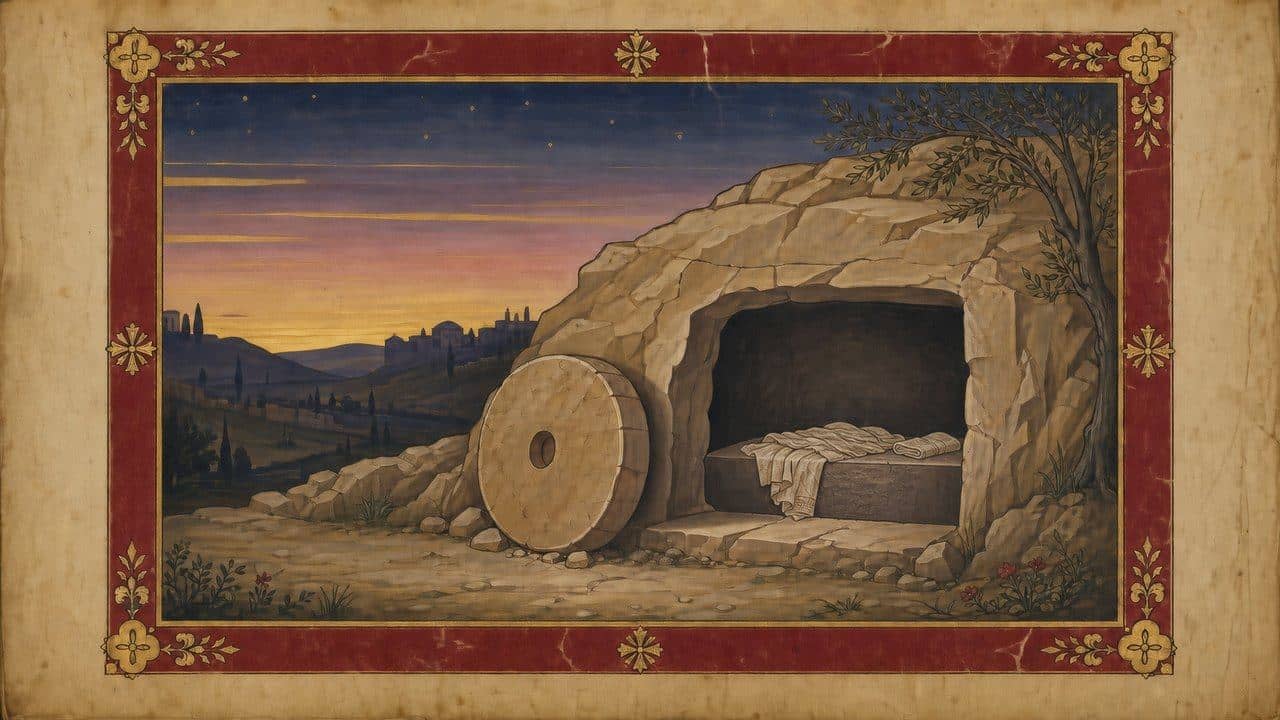
Illuminated-manuscript interpretation of an open rock-cut tomb at dawn, with burial linens resting inside.
Interpretive illuminationThe accounts begin after the event, at a tomb already open.

Before you start

No source describes the resurrection itself. Every account begins at a tomb already open.

What the sources agree onHe was crucified, died, and was buried. His followers then reported encounters with him alive.
What they report differentlyThe hour, the last words, who reached the tomb, the messengers, and the order and location of the appearances.
The boundaryHistory can date the testimony, weigh the sources, and show what was claimed and how early. The act itself is confessed, not reconstructed.
MethodHow this page handles sources

Friday, the third hour to sunset

The death

What do the sources actually report in those hours?

Four accounts of the same afternoon. They agree on the execution and the burial; they diverge on the hour, the last words, and the centurion's verdict.

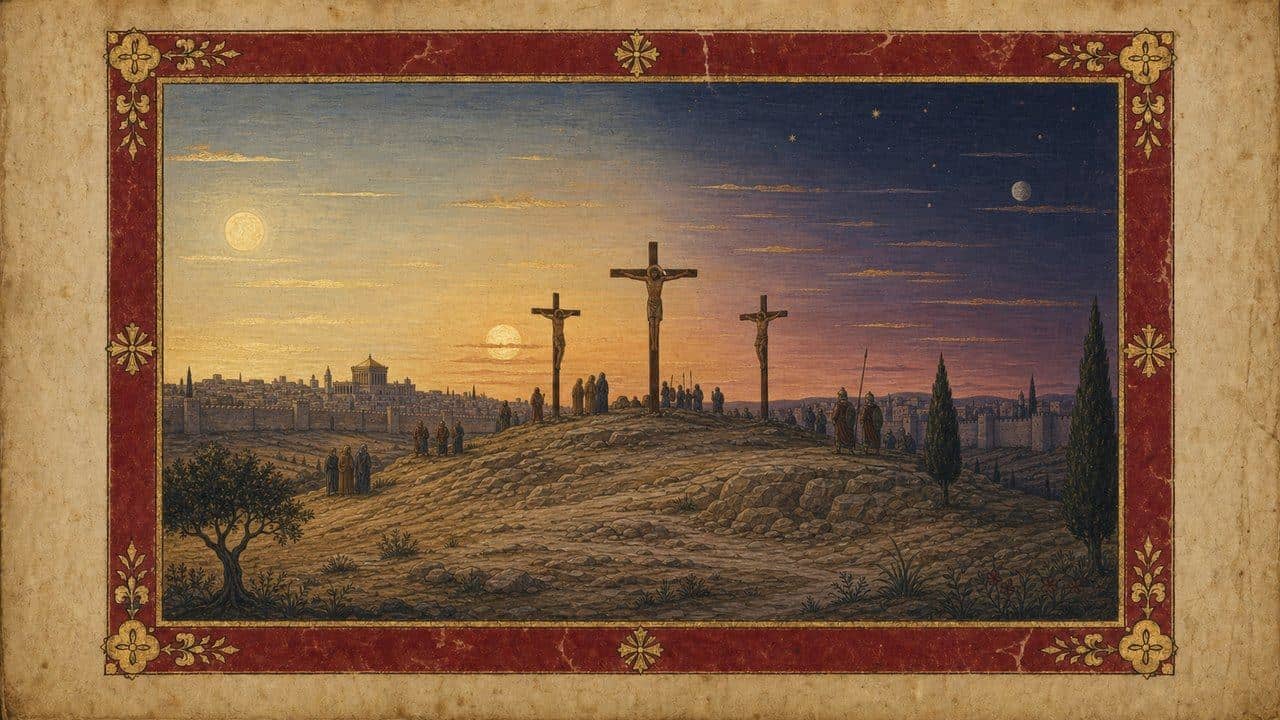
Illuminated-manuscript panorama of three distant crosses as daylight gives way to darkness over Jerusalem.
Interpretive illuminationThe reported hours, compressed from daylight into darkness.
  1. The third hour

    Crucified between two others

    Mark gives the hour. All four place two others beside him.

    Reported by: All four Gospels

    Where the accounts differMark has him on the cross by the third hour; John still has Pilate giving sentence at about the sixth.

  2. The sixth hour

    Darkness over the land

    Three hours of it, until the ninth hour.

    Reported by: Matthew, Mark, and Luke

  3. The ninth hour

    “My God, my God, why have you forsaken me?”

    The opening line of Psalm 22, cried in Aramaic.

    Reported by: Matthew and Mark

  4. At the death

    The temple curtain torn

    Torn in two, from the top to the bottom.

    Reported by: Matthew, Mark, and Luke

  5. Before sundown

    The spear, the blood and water

    The soldiers break the legs of the other two, find him already dead, and pierce his side instead.

    Reported by: John only

    Where the accounts differJohn alone reports it, and stops the narrative to insist on an eyewitness for it.

  6. Before sundown

    Joseph of Arimathea asks for the body

    A member of the council takes the body, wraps it, and lays it in a tomb cut in rock.

    Reported by: All four Gospels

  7. Before sundown

    The women see where he is laid

    Named women watch the burial and mark the place.

    Reported by: Matthew, Mark, and Luke

Evidence laneCompare the death accounts

These details belong to the same afternoon, but they compare what individual writers include rather than advance the clock.

Across the hours

Seven sayings from the cross

Forgiveness, the promise to the criminal, his mother and the disciple, thirst, the cry of dereliction, “it is finished,” and the commending of his spirit.

No single Gospel records all seven

What needs explainingThe traditional seven is a harmony, not a source. Luke carries three, John three, Matthew and Mark one — the same one.
At the death

The earthquake and the opened tombs

Rocks split, tombs opened, and bodies of the saints raised — appearing to many after his own resurrection.

Matthew only

What needs explainingNo other source mentions it, inside the New Testament or outside it.

At the death

The centurion's verdict

The officer in charge of the execution says something. What he says depends on the source.

Matthew, Mark, and Luke

What needs explainingMatthew and Mark: “the Son of God.” Luke: “a righteous man.”

By sunset the body is in a rock-cut tomb, and the women know where it has been laid. Then the narrative goes quiet.

Friday evening to Sunday before dawn

The three days

Where was he?

No Gospel narrates the sabbath. The New Testament answers the question elsewhere, in scattered lines, and later writers filled the silence with more.

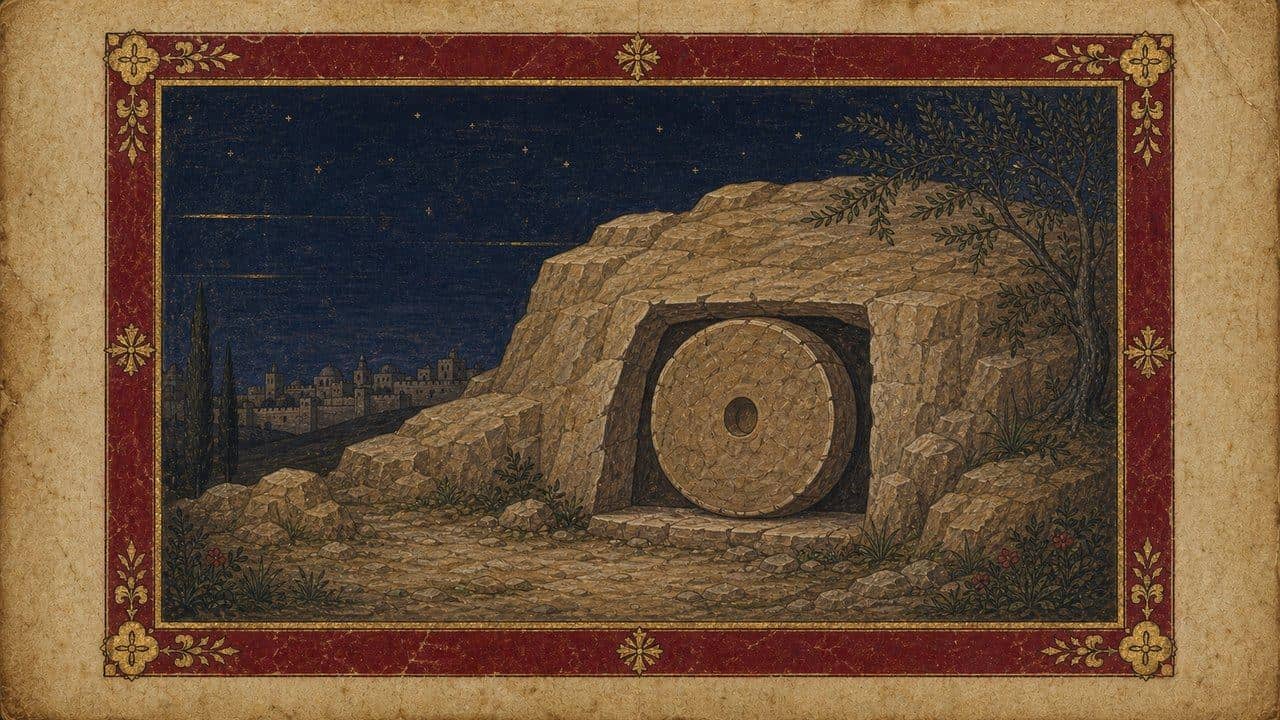
Illuminated-manuscript interpretation of a closed rock-cut tomb beneath a dark Sabbath sky.
Interpretive illuminationThe Sabbath day the Gospels leave unnarrated.
  1. The next day

    The guard and the sealed stone

    The chief priests ask Pilate to secure the tomb until the third day.

    Reported by: Matthew only

    Where the accounts differMatthew is also the only Gospel that names the counter-story it answers — that the disciples stole the body.

  2. The sabbath

    The day no Gospel narrates

    Luke says the women rested according to the commandment. Then the record goes quiet for a full day.

    Reported by: No Gospel narrates the sabbath

Evidence laneRead the passages later used to describe the interval

These lines were spoken before the burial or interpreted afterward. They address the silence, but they are not events narrated during the sabbath.

Said from the cross

“Today you will be with me in paradise”

Said to the criminal beside him; later readers asked how “today” relates to the three-day interval.

Luke only

Said in advance

Three days and three nights in the heart of the earth

The sign of Jonah, given before the fact.

Matthew only

What needs explainingFriday evening to Sunday dawn spans parts of three calendar days but two nights; readers usually appeal to inclusive Jewish day-counting.

Read backwards

“He went and preached to the spirits in prison”

The clearest New Testament statement that something happened while he was dead — and the most argued over.

1 Peter

Read backwards

“He also descended into the lower parts of the earth”

Paul reads a psalm about ascent, and infers a descent behind it.

Ephesians

What needs explaining“The lower parts of the earth” has been read as the grave, as the underworld, and simply as the earth itself.

Read backwards

“Not abandoned to Hades”

Peter's Pentecost sermon applies Psalm 16 to him: his soul was not left in Hades, nor his flesh left to decay.

Acts, quoting Psalm 16

Read backwards

“I have the keys of Death and of Hades”

Said by the risen Christ in the opening vision of Revelation.

Revelation

Read backwards

“Who will descend into the abyss?”

Paul's rhetorical question — that is, to bring Christ up from the dead.

Romans

How later writers filled the silence

Later Christian texts supplied the journey the Gospels leave out. Each record below states what it shows and where it stops.

Later traditionRead 7 descent texts, oldest first
Early Christian letterIgnatius, To the Magnesiansc. AD 105–115
The prophets waited for him as their teacher, and when he came he raised them from the dead.
What this showsA bishop writing within roughly eighty years of the crucifixion already assumes he did something for the righteous dead. It is the earliest surviving trace of the idea.
Where it stopsOne clause inside a letter about church unity. It assumes the idea rather than reporting an event.

Read the letter here

HymnOdes of Solomon 42Late 1st to 2nd century
He goes down to Sheol; the dead run to him, ask to be led out, and he sets his name upon their heads.
What this showsThe oldest surviving collection of Christian hymns puts the descent in the first person and sings it as rescue.
Where it stopsPoetry, and its date, language of origin, and community are all disputed. It shows what was sung, not what was witnessed.

Harris and Mingana edition

VisionThe Ascension of Isaiahc. AD 70–150, composite
The Beloved descends through the seven heavens unrecognized, taking the form of each as he passes, and afterwards rises with every heaven watching.
What this showsAn early Christian picture in which the going-down and the going-up are one movement rather than two events.
Where it stopsA vision, not a report. Its Christian chapters are debated in date, and it was never received as scripture.

Read the text here

Gospel outside the canonThe Gospel of Peter2nd century; surviving copy much later
Two figures whose heads reach heaven bring him out of the tomb, the cross follows them, and a voice from heaven asks whether he preached to those who sleep. The cross answers yes.
What this showsThat by the second century a Christian narrative already had him preaching to the dead — and that someone was willing to narrate the exit from the tomb.
Where it stopsA single fragment, recovered at Akhmim in 1886 in a copy centuries later than the text. It was not received as scripture, and its passion narrative departs from all four Gospels.

Ante-Nicene Fathers translation

Dialogue outside the canonEpistula Apostolorum2nd century (c. AD 120–170)
The risen Christ answers the apostles' questions directly, including what he did for those who had already died.
What this showsThat the forty days were being filled in with dialogue within a century, by writers who felt the Gospels had left the period thin.
Where it stopsWritten to teach, in the voice of the risen Christ. Read it as second-century theology, not as testimony to the forty days.

Read the text here

LegendThe Descent into Hell (Gospel of Nicodemus)Descent section: 4th century and later
Two sons of Simeon return from the dead to testify: the gates of Hades broken, Adam and the patriarchs led out, and Hades arguing with Satan over who let him in.
What this showsThe fullest developed form of the harrowing, and the direct source of most later art, drama, and hymnody about it.
Where it stopsCenturies after the events, with no independent witness behind it. It records what Christians came to picture, not what anyone reported.

Acts of Pilate translation

ConfessionThe “descended” clause in the creedLatin creeds, from the 4th century
He descended to the dead.
What this showsThat by the late fourth century some Latin churches confessed a descent as part of the baptismal creed. Rufinus of Aquileia, writing around AD 404, notes the clause in his own church's creed and observes that the Roman form does not carry it.
Where it stopsA creed records what a church confessed, not a source for what happened. The clause is later than the New Testament lines it summarizes, and churches have never agreed on what it means.

Nicene and Post-Nicene Fathers

When the story resumes before dawn, the tomb is open and the body is gone. The accounts now turn from absence to reported encounters.

Sunday, and the weeks after

The forty days

Who saw him, and where?

Reports begin on Sunday and continue through the weeks after. No single source carries the whole sequence, and Acts alone numbers the span as forty days.

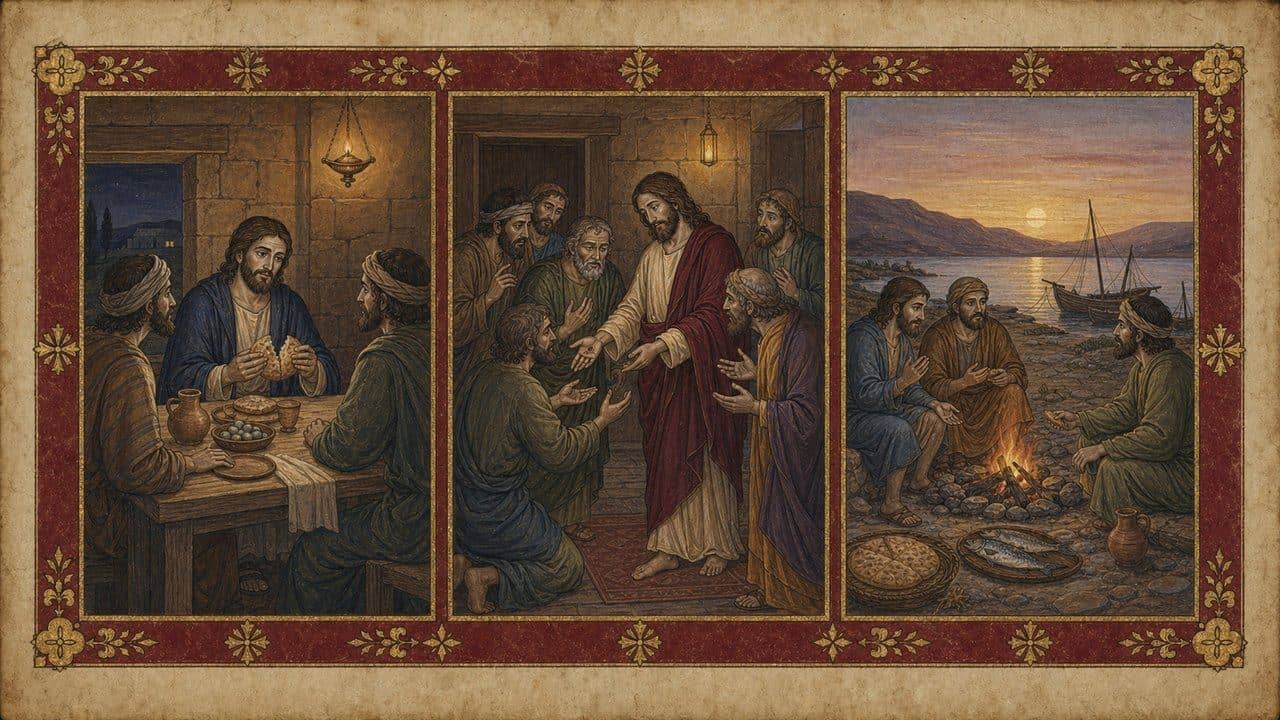
Three-panel illumination showing bread broken at Emmaus, Jesus offering his wounded hand indoors, and disciples beside a shore fire.
Interpretive illuminationThree reported modes of recognition: broken bread, offered wounds, and a shared meal.
  1. Sunday, before dawn

    The stone is already moved

    Every account arrives at a tomb that is already open.

    Reported by: All four Gospels

    Where the accounts differNo source in the New Testament describes the rising itself. Not one.

  2. Sunday, early

    Someone is waiting at the tomb

    A figure, or two, tells the women he is not there.

    Reported by: All four Gospels

    Where the accounts differMatthew has an angel and Mark a young man — one figure. Luke has two men, John two angels.

What happens next

From the garden to Galilee

The accounts do not supply one complete itinerary. Read in their broad sequence, the reports move from the tomb and Jerusalem toward Galilee.

  1. Sunday, early · The garden, at the tomb

    Mary Magdalene

    She takes him for the gardener until he says her name.

  2. Sunday, early · On the road back to the city

    The women returning from the tomb

    He meets them as they run to tell the others.

  3. Sunday · Not stated

    Simon Peter

    Two sources report it. Neither narrates it.

  4. Sunday afternoon · The road to Emmaus

    Two disciples, one named Cleopas

    He walks with them unrecognized, and they know him when he breaks the bread.

  5. Sunday evening · A locked room in Jerusalem

    The eleven and those with them

    He shows them his hands and side, and asks for something to eat.

  6. Eight days later · The same room

    Thomas, with the rest

    He offers Thomas the evidence Thomas asked for.

  7. Not stated · The Sea of Tiberias

    Seven disciples

    A night of empty nets, then breakfast on the shore.

  8. Not stated · A mountain in Galilee

    The eleven

    The commission — and the note that some doubted.

Source clock

The earliest written list

Died, buried, raised on the third day, appeared — to Cephas, the twelve, five hundred, James, all the apostles, and last of all to Paul.

Paul calls it handed-on material, which puts the formula earlier than the letter carrying it.

Compare the appearance reports, by source

Source matrix12 reports across 6 books

No source carries them all, and the earliest list is not a Gospel. Open any reported cell to read the passage.

Reported appearances of the risen Jesus, by source. Each cell links to the passage; an empty cell means that source does not report it.
Who saw himMattMarkLukeJohnActs1 Cor
Mary MagdaleneThe garden, at the tomb · Sunday, earlyNot reported hereMark 16:9Not reported hereJohn 20:11–18Not reported hereNot reported here
The women returning from the tombOn the road back to the city · Sunday, earlyMatthew 28:9–10Not reported hereNot reported hereNot reported hereNot reported hereNot reported here
Simon PeterNot stated · SundayNot reported hereNot reported hereLuke 24:34Not reported hereNot reported here1 Corinthians 15:5
Two disciples, one named CleopasThe road to Emmaus · Sunday afternoonNot reported hereMark 16:12–13Luke 24:13–32Not reported hereNot reported hereNot reported here
The eleven and those with themA locked room in Jerusalem · Sunday eveningNot reported hereMark 16:14Luke 24:36–43John 20:19–23Not reported hereNot reported here
Thomas, with the restThe same room · Eight days laterNot reported hereNot reported hereNot reported hereJohn 20:26–29Not reported hereNot reported here
Seven disciplesThe Sea of Tiberias · Not statedNot reported hereNot reported hereNot reported hereJohn 21:1–14Not reported hereNot reported here
More than five hundred at onceNot stated · Not statedNot reported hereNot reported hereNot reported hereNot reported hereNot reported here1 Corinthians 15:6
JamesNot stated · Not statedNot reported hereNot reported hereNot reported hereNot reported hereNot reported here1 Corinthians 15:7
All the apostlesNot stated · Not statedNot reported hereNot reported hereNot reported hereNot reported hereNot reported here1 Corinthians 15:7
The elevenA mountain in Galilee · Not statedMatthew 28:16–20Not reported hereNot reported hereNot reported hereNot reported hereNot reported here
The apostles, over forty daysJerusalem and around it · Up to the ascensionNot reported hereNot reported hereNot reported hereNot reported hereActs 1:3Not reported here
  1. Mary MagdaleneShe takes him for the gardener until he says her name.Mark's notice belongs to the longer ending.
  2. The women returning from the tombHe meets them as they run to tell the others.
  3. Simon PeterTwo sources report it. Neither narrates it.Paul's list begins here.
  4. Two disciples, one named CleopasHe walks with them unrecognized, and they know him when he breaks the bread.
  5. The eleven and those with themHe shows them his hands and side, and asks for something to eat.
  6. Thomas, with the restHe offers Thomas the evidence Thomas asked for.
  7. Seven disciplesA night of empty nets, then breakfast on the shore.
  8. More than five hundred at onceThe largest reported appearance, and the least described.Paul adds that most were still alive when he wrote — an invitation to go and ask.
  9. JamesNamed on his own in the earliest list, and nowhere else.
  10. All the apostlesA second group sighting, distinct from the twelve.
  11. The elevenThe commission — and the note that some doubted.
  12. The apostles, over forty daysActs summarizes the whole span rather than listing sightings.

Beyond the forty days

Paul, years later

He puts his own sighting on the same list, and calls it last of all.

Different in kind from the rest — after the ascension, and by his own account out of due time.

The reports move from one Sunday to repeated encounters over a span Acts alone numbers as forty days. Then Luke brings the witnesses to Olivet.

The fortieth day, and ten days after

The ascension

How did it end, and what began?

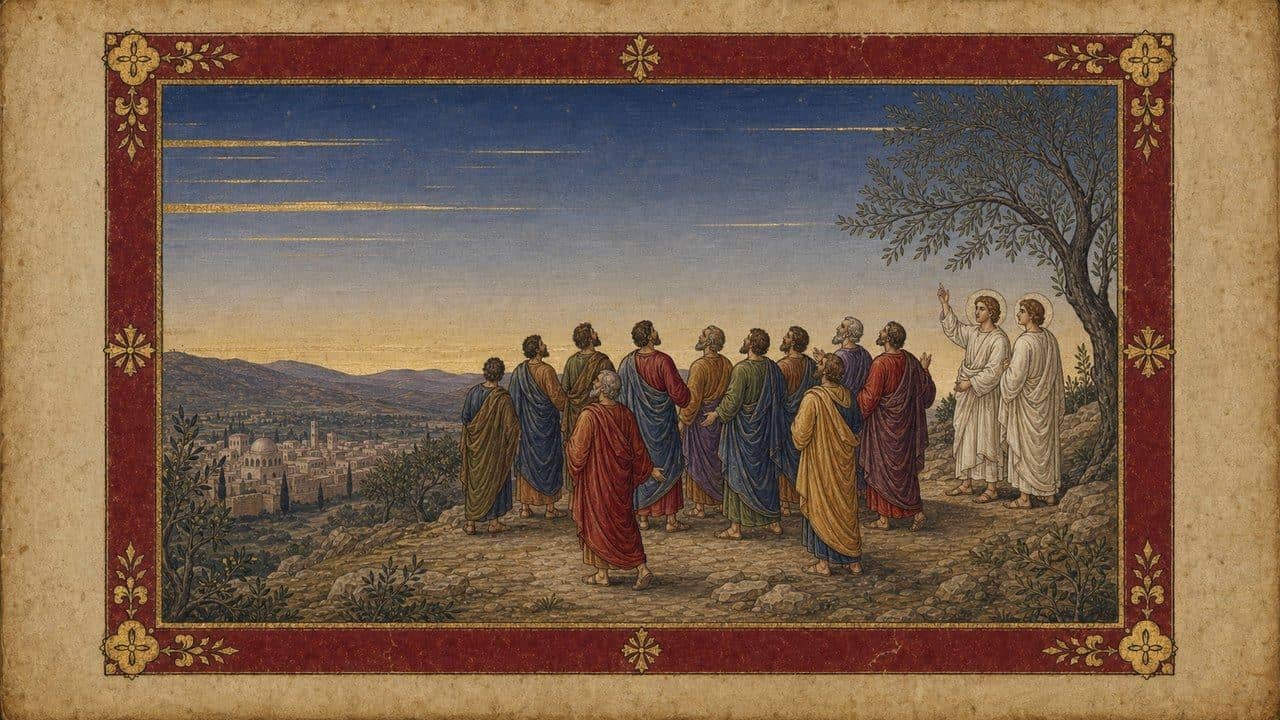
Luke ends his Gospel with a departure near Bethany and begins Acts with the view from Olivet. The witnesses return to Jerusalem, and the story turns toward them.

Illuminated-manuscript interpretation of the apostles looking into an empty sky on the Mount of Olives, with two figures in white nearby.
Interpretive illuminationActs turns the witnesses from an empty sky back toward Jerusalem.
  1. Forty days

    The number comes from one source

    Acts alone gives the span, and says he spoke of the kingdom of God through it.

    Reported by: Acts only

  2. The last day

    Led out as far as Bethany

    He lifts his hands, blesses them, and is parted from them.

    Reported by: Luke only

  3. The last day

    Taken up, and a cloud received him

    They are still watching when the cloud takes him out of sight.

    Reported by: Acts

  4. The last day

    “Why do you stand looking into the sky?”

    Two men in white ask the question, and promise a return in the same manner.

    Reported by: Acts

  5. The last day

    They walk back from Olivet

    A sabbath day's journey from the city — the one geographic detail given.

    Reported by: Acts

  6. Ten days later

    What starts next

    The record stops following him and starts following them.

    Reported by: Acts

Evidence laneCompare Mark's later ending

Mark's one-line summary belongs to the longer ending, so it sits beside the event sequence rather than inside it.

The last day

Mark's one-line ascension

Received up into heaven, and seated at the right hand of God.

Mark's longer ending

What needs explainingThese verses are absent from the earliest complete manuscripts of Mark.

Reception history

Outside the canon: how later Christians continued the story

These works are evidence for how the resurrection was retold and interpreted after the New Testament sources. They are not additional rows in the event timeline.

Noncanonical archiveExplore 8 texts, with dates and historical limits

Retelling the event

Narratives that make visible what the New Testament leaves offstage.

Passion and resurrection narrativeThe Gospel of Peter2nd century; exact date disputed
What survives
Fragmentary Greek witnesses. The principal passion-and-resurrection copy is centuries later than the proposed composition.
What it adds
Soldiers guard the tomb and witness two immense figures bringing out a third, followed by a cross that answers a voice from heaven. The women arrive afterward and find the tomb open.
What this establishesBy the second century, at least one Christian retelling made the resurrection itself visible and expanded the guarded-tomb tradition dramatically.
Where it stopsThe work is fragmentary, later than the New Testament sources, and its literary relationship to the canonical Gospels is debated. It is not another eyewitness report.
NASSCAL scholarly catalog

Additional appearances and teaching

Works that use an encounter with the risen Jesus to authorize further instruction.

Revelatory dialogue and epistleThe Epistle of the Apostles2nd century, often placed in its later decades
What survives
A fragmentary Coptic codex from the 4th or 5th century, a Latin palimpsest, and a complete text in later Ethiopic manuscripts.
What it adds
The eleven present an extended dialogue with the resurrected Christ about resurrection, judgment, Gentiles, false teaching, and Paul, continuing until a final ascension scene.
What this establishesA second-century writer used the forty-day gap as a setting for instruction and defended a particular version of apostolic teaching in the apostles' collective voice.
Where it stopsThe work draws on earlier Jesus traditions and speaks pseudonymously. It records second-century theology and church conflict, not an additional first-generation appearance account.
NASSCAL scholarly catalog
Secret-book dialogueThe Apocryphon of JamesLater 2nd century, commonly proposed
What survives
One damaged Coptic copy in the 4th-century Nag Hammadi Codex I.
What it adds
Jesus singles out James and Peter for private post-resurrection teaching about suffering, the kingdom, and understanding. His departure becomes an ascension sequence.
What this establishesLater Christians placed competing claims about authority and suffering into private conversations between the risen Jesus and favored disciples.
Where it stopsIts author is unknown, the identity of James is ambiguous, and only one later manuscript survives. It cannot supply an independent itinerary of appearances.
NASSCAL scholarly catalog
Post-resurrection dialogue gospelThe Gospel of Mary2nd century, commonly proposed
What survives
Two 3rd-century Greek fragments and a 4th- or 5th-century Coptic copy. Less than half of the work survives, and its opening is lost.
What it adds
The preserved text closes a dialogue with Jesus, then presents Mary's vision and her disputed teaching. Peter and Andrew challenge her; Levi defends her.
What this establishesThe risen-Jesus setting could authorize Mary's teaching and expose arguments over who understood Jesus and who was permitted to speak for him.
Where it stopsThe lost opening probably contained the appearance, but that scene is not preserved. The surviving work is theological dialogue, not a recoverable event sequence.
NASSCAL scholarly catalog
Revelatory dialogueThe Wisdom of Jesus ChristDate disputed: late 1st or early 2nd century to the 3rd
What survives
Greek and Coptic witnesses copied in the 4th and 5th centuries.
What it adds
Disciples and women gather on a mountain in Galilee after the resurrection. The Savior appears and answers thirteen rounds of questions about the universe, divine powers, mortality, and salvation.
What this establishesMatthew's Galilean mountain became a reusable setting for later cosmological teaching delivered by an appearing Savior.
Where it stopsThe work reshapes material from Eugnostos the Blessed, and its date is unusually disputed. Its scene functions as a literary frame for theology rather than an event report.
NASSCAL scholarly catalog
Letter-framed revelatory dialogueThe Letter of Peter to PhilipLate 2nd to early 3rd century, often proposed
What survives
Two broadly comparable 4th-century Coptic copies, in Nag Hammadi Codex VIII and Codex Tchacos.
What it adds
The reunited disciples gather on the Mount of Olives. Jesus appears as a great light and voice, answers questions, ascends, and commissions them before they return to Jerusalem.
What this establishesA later community rewrote the Olivet and Pentecost pattern around unity, persecution, cosmic powers, and Peter's leadership.
Where it stopsThe scene echoes Acts while serving a distinct theological system. Its two later manuscripts preserve reception history, not independent evidence for the ascension.
NASSCAL scholarly catalog

Later expansions

Texts that stretch the setting into Hades, cosmic revelation, or years of secret teaching.

Apocalyptic question-and-answer dialogueThe Questions of Bartholomew2nd to 4th century; composition and development debated
What survives
Several divergent language versions. The principal Greek manuscripts are medieval, copied from the 13th to 15th centuries.
What it adds
Bartholomew questions Jesus about the crucifixion, the descent to Hades, heaven, the abyss, and Satan. Some versions place the exchange after the resurrection; one places it before.
What this establishesThe unanswered interval and the authority of Bartholomew became a framework for increasingly elaborate explanations of Hades and the unseen world.
Where it stopsIts versions disagree even about when the dialogue occurs, and the surviving copies are late. It is evidence for a developing tradition, not a stable early narrative.
NASSCAL scholarly catalog
Extended revelatory dialoguePistis Sophia2nd- and 3rd-century layers have been proposed; composite
What survives
One Sahidic Coptic manuscript, the Askew Codex, copied around AD 250-300.
What it adds
Its main frame says Jesus taught the disciples for eleven years after the resurrection before revealing higher mysteries. Another section returns to a Galilean mountain immediately after the resurrection.
What this establishesThe post-resurrection period could be expanded almost without limit and used to authorize a large body of ritual, cosmological, and salvific teaching.
Where it stopsThe work is internally inconsistent and appears to compile multiple texts. Its eleven-year setting belongs to a later theological world, not the chronology of Acts.
NASSCAL scholarly catalog

Where the accounts differ

The questions a careful reader hits first.

These are not objections collected from outside. They are what the sources say when you lay them side by side, and every one of them has been argued over inside the church for as long as there has been one.

Compare 6 questions the sources leave open

Does the earliest Gospel have a resurrection appearance?

As we have it in the oldest complete manuscripts, no. Mark ends at 16:8 with the women running from the tomb, afraid, saying nothing to anyone. The twelve verses that follow — the appearances, the ascension, the signs — are absent from Codex Sinaiticus and Codex Vaticanus, and read in a different style. Most printed Bibles carry them with a note. This room marks them wherever they are used.

Galilee, or Jerusalem?

Matthew and Mark send the disciples north to Galilee, and Matthew's climax happens on a mountain there. Luke keeps them in and around Jerusalem and has them told to stay in the city. Both cannot be the whole picture; harmonies exist, but they are readings, not sources.

One messenger at the tomb, or two?

Matthew has an angel and Mark a young man in white — one figure. Luke has two men in dazzling clothing, John two angels seated where the body had been. Some readers harmonize this by saying one writer mentions only the speaker; others treat it as variation in retelling. The sources themselves do not explain the difference.

The same day, or forty days later?

Luke 24 reads as one continuous day that ends with the ascension at Bethany. Acts 1 — the same author, writing to the same reader — gives forty days. Luke's Gospel compresses; Acts spells it out. The forty-day figure rests on that one verse.

Why are the women missing from the earliest list?

Paul's list is the earliest written account of the appearances, and it begins with Cephas. The women, who come first in all four Gospels, are not in it. Readers have explained this by the conventions of a formal witness list; the plain fact is that the earliest source omits the first witnesses, and the later sources put them first anyway.

Did anyone claim to see the rising itself?

No New Testament source does. Every account begins at a tomb that is already open. The first text to narrate the exit is the Gospel of Peter, in the second century, and it is not a witness — it is a story written later, by someone filling the same gap everyone else felt.

Where the record lands

The shared claim is clear. The sequence is not.

Across the Gospels, Acts, and Paul, the shared claim is that Jesus died, was buried, and was afterward reported alive. The books differ over who arrived when, where appearances occurred, and how the sequence unfolded. History can date and compare those claims; it cannot reconstruct the resurrection itself.

See how the outside witnesses are weighed