Sources & method
Source basis: Road steps, councils, faces, and claims cite their source records inline; dark chapters are stated beside bright ones. Sources
Browse this section
The church
The road from the upper room.
The church begins with about a hundred and twenty people praying in a borrowed room. This page walks from there to today — every step dated and sourced, the dark chapters stated as plainly as the bright ones. And at every era, the same question: who held the power, and what did they do with it?
- Two thousand years
- Every major fork
- Sources inline
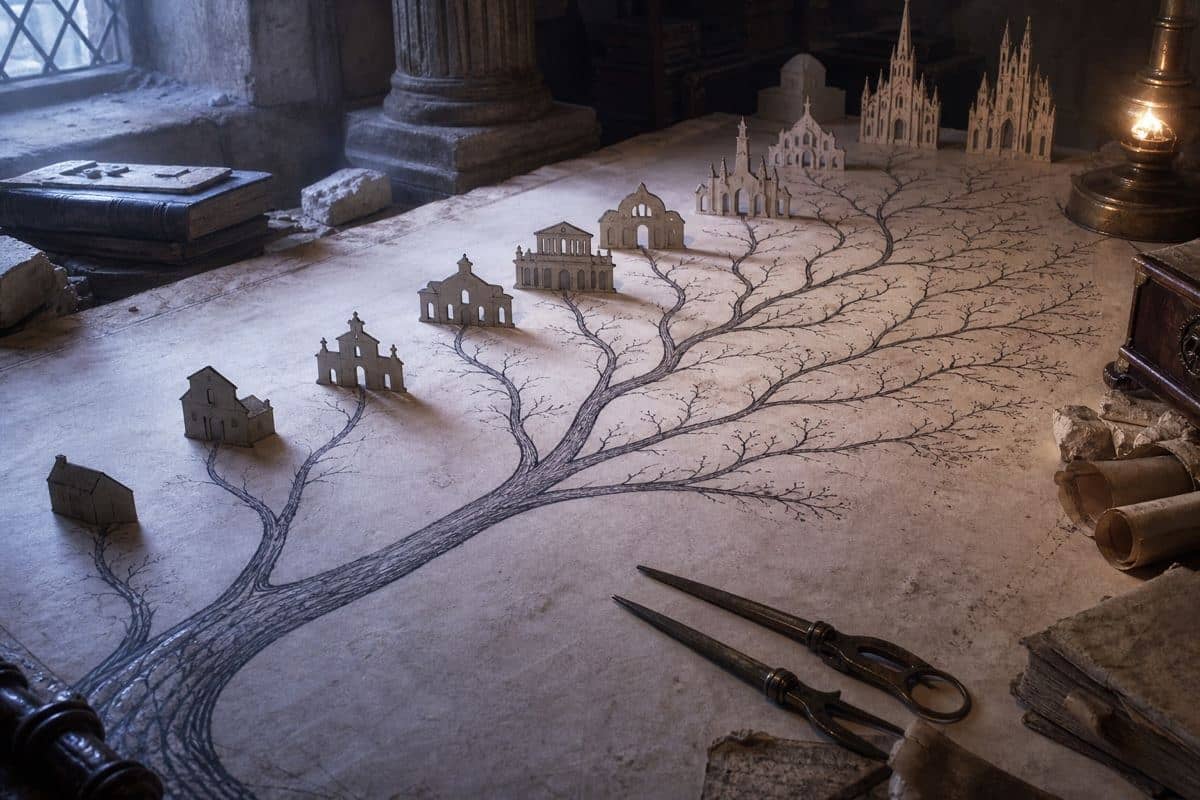
Walk the road
Begin with the upper room
Follow the sourced road from the first gathering to today.
Open the historical roadOpen the full church-history roadWalk every sourced era from the upper room to today.
The upper room
c. AD 30–49About a hundred and twenty people, a borrowed room, and wind and fire. Within twenty years the movement has crossed three provinces, survived its first killing, and gained its name.
Who held the power: No one, in the later sense. Decisions are made by the apostles and elders together, with the whole assembly — argued openly, settled together.
Stephen, the first martyr
The Stephen is stoned in Jerusalem after his defense before the council; a young man named Saul of Tarsus stands by, approving.
Antioch — first called Christians
Scattered believers preach to Greeks in ; Barnabas and Saul teach there a year. “The disciples were first called Christians in Antioch” (Acts 11:26).
Read it here:Acts 11:26
The Jerusalem council
The church's first recorded collective decision: must keep the law of Moses? Peter and James lead, but the matter is decided by “the apostles and the elders, with the whole assembly” after open debate — no single ruler decrees.
For it seemed good to the Holy Spirit, and to us, to lay no greater burden on you than these necessary things.
The apostles scatter
49–100Paul walks and sails the eastern Mediterranean planting churches; Rome starts killing Christians; Jerusalem falls; and by the century's end the founding generation is gone.
Who held the power: Still local and plural — overseers and deacons in each city. When Rome writes to Corinth, it argues and pleads from apostolic precedent; it cannot command.
Paul's missions
Three journeys through Cyprus, Asia Minor, and Greece, planting churches and leaving letters that will become Scripture.
Nero blames the Christians
After the great fire of Rome, 's persecution is the first imperial campaign against Christians — ' account of it is quoted in the Jesus world's historical record.
Peter and Paul die
Tradition, broadly accepted by scholars, places both martyrdoms in Rome under Nero — Peter's not recorded in the New Testament itself; the earliest witness to his Vatican grave-marker is c. 200.
The temple falls
Titus besieges Jerusalem and the Second Temple is destroyed. Jewish Christianity loses its geographic center; the church's weight shifts to the Gentile world.
John at Patmos
Revelation is written from the island of , most scholars say late in 's reign. Tradition identifies its John with the apostle; the book itself never says so, and modern scholarship is divided.
Church order emerges
The letters already assume local officers — “overseers and deacons” (Philippians 1:1), with qualifications listed (1 Timothy 3). Plural leadership per city; the one- model comes later.
Read it here:Philippians 1:11 Timothy 3
Rome writes to Corinth
's letter urges Corinth to reinstate its deposed — the earliest surviving church-to-church intervention, argued from apostolic succession. You can read the whole letter in the Early Writings world.
For our sin will not be small, if we eject from the episcopate those who have blamelessly and holily fulfilled its duties.
Read it here:1 Clement
Under the sword
100–313Two centuries as an illegal religion: local mobs, imperial tests, and executions that keep failing to work. Meanwhile the church quietly builds the structures that will define it.
Who held the power: The bishop rises — one man per city, guardian of the true teaching against the . Rome's only power over the church is to kill its members; the church's own power struggles are over who may forgive.
Ignatius and the one bishop
Marched under guard to his execution in Rome, of Antioch writes seven letters urging each church to unite around a single bishop — the earliest strong witness to the one-bishop model. His whole road is drawn in the Early Writings world.
See that ye all follow the bishop, even as Jesus Christ does the Father… Wherever the bishop shall appear, there let the multitude also be; even as, wherever Jesus Christ is, there is the Catholic Church.
Read it here:Ignatius — To the RomansIgnatius — To the SmyrnaeansIgnatius — To the Magnesians
Pliny asks what to do with them
Governor asks how to try Christians; the emperor answers: don't hunt them, punish the unrepentant, pardon any who recant by sacrificing. Christianity is punishable — but prosecution stays passive.
Polycarp burned at Smyrna
The aged bishop, a living link to the apostles' generation, refuses to renounce Christ and is executed. The letter recording it — the earliest account outside the New Testament — dates it around 155; says 167–168.
Read it here:The Martyrdom of Polycarp
Irenaeus against the gnostics
of Lyon answers gnosticism with three tests: the Scriptures, the rule of faith, and the succession of bishops from the apostles — strengthening episcopal authority as the safeguard of truth.
Decius: sacrifice, or else
The first empire-wide test: every inhabitant must sacrifice before commissioners and carry the certificate. Many Christians lapse — and afterwards the church splits over who has power to forgive them. The Novatianist is a fight over the keys.
Antony walks into the desert
Antony of Egypt withdraws to the desert and imitators follow — the beginning of organized monasticism, a source of spiritual authority that never sits in the bishop's chair.
Diocletian's Great Persecution
The last and largest persecution: churches razed, scriptures burned, clergy arrested, sacrifice compelled. It fails. Ten years later, toleration.
The empire converts
313–451In one lifetime the church goes from hunted to tolerated to established to compulsory. It gains peace, buildings, and councils — and a partner it never chose: the state.
Who held the power: The emperor walks into the council chamber. He does not write the creed — the bishops do — but he convenes, funds, enforces, and exiles. Within seventy years, dissent from the creed is a civil offense.
The Edict of Milan
and Licinius grant full toleration: legal standing, confiscated property returned. It did not make Christianity the official religion — it freed every religion.
All who choose that religion are to be permitted, freely and absolutely, to remain in it, and not to be disturbed any ways, or molested.
Nicaea — an emperor convenes the church
Constantine calls the first council, presides over its opening as an unbaptized , and enforces its verdict with exile. The ~300 bishops debate and define the doctrine — , “of one substance with the Father” — but the state is now inside the room.
The state religion
Theodosius' Edict of Thessalonica makes Christianity the empire's religion and calls dissenters “foolish madmen” liable to punishment; the Council of Constantinople (381) completes the creed still said today. is now a civil offense.
Chrysostom exiled by a palace
John , the preacher-archbishop of Constantinople, offends the empress; a synod of rivals deposes him, and he dies on a forced march into exile. Imperial power can now remove a bishop it dislikes.
Augustine accepts coercion
The Donatist schism held that clergy who caved under persecution forfeit valid ministry. first opposed coercing them; after years of failed persuasion he accepted imperial force against the schism, while opposing executions. An honest data point: the church's greatest theologian changed his mind toward compulsion.
Ephesus
The third ecumenical council condemns Nestorius over the title Theotokos — “God-bearer” — for Mary. The rivalry of the great sees, against Constantinople, is now part of doctrinal politics. The church of the Persian Empire goes its own way.
Chalcedon — the definition that divides
The council defines Christ as one person in two natures, “without confusion, change, division, or separation.” The churches of Armenia, Egypt, Syria, and Ethiopia cannot accept the formula — they confess one united divine-human nature (miaphysitism, from Cyril's own words), not the “monophysite” caricature long pinned on them. Imperial pressure is entangled with the theology on both sides. The first lasting division.
One becomes many
451–1054The east enforces and loses the churches that cannot sign it. The west loses the empire itself, and the pope inherits a city. By the era's end, the two halves of the imperial church can no longer read each other.
Who held the power: Fragmenting and migrating: emperors enforce councils in the East; in the West the pope governs Rome because no one else will. Monks build a parallel authority out of prayer and work.
Armenia says no at Dvin
The Armenian church — the world's oldest national church, Christian since c. 301 — rejects Chalcedon's ruling at the council of Dvin in 506 and seals the break at the Second Council of Dvin in 554. With the Coptic, Syriac, and Ethiopian churches it forms the Oriental Orthodox communion.
Benedict writes his Rule
At Monte Cassino, Benedict composes a moderate, ordered rule built around prayer and work. It becomes the charter of Western monasticism — which will carry literacy and agriculture through the collapse of Roman order.
We are, therefore, about to found a school of the Lord's service, in which we hope to introduce nothing harsh or burdensome.
Gregory fills the vacuum
With imperial administration gone from Italy, Pope Gregory I feeds Rome, negotiates with Lombard armies, and administers vast estates — a civil power assumed almost by default, and kept. He styles himself “servant of the servants of God.”
The war over images
Byzantine emperors ban religious images; monks and ordinary believers resist, some dying for it — a century-long struggle over whether the emperor can dictate worship. It ends with the icons restored, a feast the Orthodox still keep.
An alphabet for the Slavs
Cyril and Methodius, sent from Constantinople to Moravia, create an alphabet for the Slavonic tongue and put the Scriptures and liturgy into the people's own language — language given, not imposed.
The Photian quarrel
Pope Nicholas I and Photius excommunicate each other in a dispute tangled with jurisdiction and the filioque clause. It heals — but the fault line is now visible.
The bull on the altar
Cardinal Humbert lays a sentence of excommunication on the altar of Hagia Sophia against Patriarch Michael Cerularius, who returns the favor. It targeted individuals, not churches — the pope who sent Humbert was already dead — and contemporaries did not call it “the schism.” Hindsight did, hardened by what came in 1204.
The high throne
1054–1517The medieval West: the papacy at the height of its power over kings and consciences. The same institution preaches crusades, charters universities, builds hospitals, runs inquisitions, and produces Francis.
Who held the power: The papacy at its peak makes an emperor kneel in the snow — and wields the state's sword against heretics. Power at its highest, doing its most magnificent and its darkest work in the same centuries.
Canossa — a king kneels in the snow
In the struggle over who appoints bishops, Gregory VII excommunicates Emperor Henry IV — who stands three days as a penitent in the snow outside Canossa to receive absolution. Peak papal power over kings; Gregory still dies in exile when the wheel turns.
Clermont — the Crusade preached
Urban II calls the First Crusade. No transcript exists — five differing versions survive — and the famous cry “Deus vult,” God wills it, is said to have come from the crowd only in an account written a decade later.
All who die by the way, whether by land or by sea, or in battle against the pagans, shall have immediate remission of sins.
Christians sack Constantinople
The Fourth Crusade, diverted from Egypt, storms the greatest Christian city on earth and loots its churches for three days — Hagia Sophia included. More than any document of 1054, this made the schism real and bitter. Pope John Paul II expressed sorrow for it eight centuries later.
Francis — the counter-current
While popes field armies, Francis of Assisi embraces poverty and preaches peace, walking unarmed into the Sultan's camp during the Fifth Crusade in 1219. Power refused, at the exact moment power peaked.
The Inquisition
Papal inquisitors — many of them friars — formalize the investigation and trial of heresy; torture is authorized in 1252, and those convicted and unrepentant can be handed to secular authorities for punishment. Neither myth nor whitewash: church courts took up the state's coercive power, with consequences that included imprisonment and execution.
The university and the hospital
Bologna, Paris, and Oxford grow up as church institutions under papal charter; the hospital network of medieval Europe — monastic infirmaries, Hôtels-Dieu, hospital orders — is likewise church-built. The era that built the Inquisition built these too.
Three popes at once
The papacy sits at Avignon under French influence for nearly seventy years; a disputed election in 1378 produces two rival popes, a council accidentally makes it three, and the Council of Constance finally elects one (1417). The high throne, broken by its own politics.
Indulgences for sale
Tetzel, commissioned to preach the indulgence funding St. Peter's Basilica, markets remission of punishment for money. The jingle about the coin in the coffer is his opponents' summary of his preaching — and a monk in Wittenberg is about to answer it.
The break
1517–1648A monk with a printing press splits Western Christendom in a generation. Reform was real on both sides; so were the wars, until Europe fought itself to the admission that armies cannot settle faith.
Who held the power: Contested absolutely: pope, emperor, kings, and city councils — and now a professor with a press. Nearly every side still believes power may compel belief; the Anabaptists, who don't, are killed by all of them.
The Ninety-five Theses
Luther disputes the indulgence trade; the theses cross Germany in weeks on the new presses. The door-nailing scene rests on a later account — what is certain is his letter to the archbishop on October 31, 1517.
The true treasure of the Church is the Most Holy Gospel of the glory and the grace of God.
Worms
Before emperor and empire, Luther refuses to recant unless convinced by Scripture and plain reason — “I cannot and will not recant anything… God help me.” The still-more-famous “Here I stand, I can do no other” is absent from the transcripts and probably a print-era addition; the refusal itself is fully attested.
One break becomes many
The Reformation runs in streams: Lutheran in Germany and Scandinavia; Reformed under Zwingli and Calvin; Anglican in England, where the 1534 Act of Supremacy is a king's power dispute as much as doctrine; and Anabaptist — believer's baptism, separation from the state.
Killed by both sides
Zurich's Protestant council drowns Felix Manz in the river; months later Catholic authorities torture and burn Michael Sattler. The one Reformation stream that renounced the sword dies by everyone else's.
Trent
The Catholic Church's own reform council: it ends the sale of indulgence offices and other abuses, mandates seminaries, and defines doctrine against the Protestant positions — genuine reform, and a hardened division.
Westphalia — exhaustion writes a principle
The Thirty Years' War leaves millions dead; the peace gives Calvinism legal parity, protects minority worship, and ends religion as a legal pretext for war between states. Not tolerance yet — but the exhausted admission that faith cannot be settled by armies.
To the ends of the earth
1648–1914The faith crosses every ocean — sometimes in the same hull as the slave ship. The era's deepest shame and its greatest reform are both church-made, and a formerly enslaved preacher names the difference for all time.
Who held the power: Established churches ride empires outward. Mission societies own plantations; Quakers and evangelicals dismantle the trade those plantations fed. Power in this era baptizes and brands with the same hand — until believers force its own book back on it.
Pietism warms the heart
Philipp Spener's Pia Desideria (1675) calls the German Lutheran churches back from cold orthodoxy to living faith, small gatherings, and works of mercy. A generation later Count Zinzendorf's Moravians at Herrnhut catch the same fire — and from 1732 send out the first large-scale Protestant missionaries, reaching the enslaved of the Caribbean a lifetime before Carey.
The Great Awakening
Revival sweeps the American colonies and Britain. Jonathan Edwards preaches it in New England, George Whitefield carries it into the open fields, and John Wesley — his heart “strangely warmed” at Aldersgate in 1738 — begins the Methodist movement. A surge of faith rising from below, outside the established church's control.
Carey sails for India
William Carey, a self-taught shoemaker turned pastor, reaches India; his Serampore mission — translation, printing, education — sets the pattern for the modern Protestant missionary movement. Catholic missions were older still: Jesuits in Asia and the Americas from the 1540s.
The church owned slaves
Stated plainly: the Church of England's own missionary society held the Codrington plantations in Barbados — and the people enslaved on them — for over a century. In 1838 the Jesuits of Maryland sold 272 enslaved people to save Georgetown's finances. In 1845 the Southern Baptist Convention was founded so that slaveholders could serve as missionaries.
And Christians ended the trade
The first recorded colonial protest against slavery came from Germantown Quakers in 1688; Wilberforce and the evangelical Clapham Sect carried the Slave Trade Act in 1807 and the Abolition Act in 1833 — passed days before Wilberforce died.
Douglass names the difference
Frederick Douglass — formerly enslaved, and a preacher — appends to his Narrative the era's sharpest theological indictment, made from inside the faith.
Between the Christianity of this land, and the Christianity of Christ, I recognize the widest possible difference — so wide, that to receive the one as good, pure, and holy, is of necessity to reject the other as bad, corrupt, and wicked.
Azusa Street
In a former stable in Los Angeles, William J. Seymour — the one-eyed son of formerly enslaved parents — leads an interracial revival marked by speaking in tongues. Within two years its missionaries reach fifty nations; the Pentecostal stream it opened now counts well over half a billion people.
Has Come. Los Angeles Being Visited by a Revival of Bible Salvation and Pentecost as Recorded in the Book of Acts.
The old map at its peak
On the eve of the First World War, about two-thirds of the world's Christians still live in Europe — the high-water mark of Western Christendom as a demographic fact, just before the great shift.
The whole world
1914–todayThe bloodiest century for the church and its fastest growth, in the same hundred years. The center of gravity leaves the West, the oldest wounds begin to close, and the oldest national church is martyred almost whole.
Who held the power: Nobody holds it all anymore. The fastest-growing streams began with no power at all — a stable on Azusa Street — and the martyred churches outlived the empires that killed them.
The Armenian Genocide
Beginning with the arrest of Armenian intellectuals in Constantinople on April 24, 1915, the Ottoman government deported and massacred its Armenian Christian population — at least 664,000 and possibly as many as 1.2 million dead by 1916, by the US Holocaust Memorial Museum's figures. The world's oldest national church, martyred almost whole; in 2015 the Armenian Church canonized the victims together.
The century of drawing together
The World Council of Churches forms in 1948 from the missionary-conference movement; the Second Vatican Council (1962–65) commits the Catholic Church to ecumenism and religious liberty.
The excommunications lifted
On December 7, 1965, in Rome and Istanbul at once, Paul VI and Patriarch Athenagoras “remove both from memory and from the midst of the Church” the sentences of 1054 — noting they had been aimed at persons, not churches — and commit them to oblivion. It lifted the anathemas; communion itself is not yet restored. The road bending back toward the beginning.
The abuse crisis breaks open
The Boston Globe's 2002 reporting forced into the open what bishops had concealed for decades: the sexual abuse of children by clergy, and its cover-up. The US bishops' own commissioned John Jay study later counted allegations against 4,392 priests involving 10,667 minors between 1950 and 2002. The gravest modern wound the church has dealt its own children is set here as plainly as the martyrs and reformers, because this road promised the dark chapters too.
The center of gravity moves south
Sub-Saharan Africa has passed Europe as the region with the most Christians — 31% of 2.3 billion — and most Christians now live in Africa, Latin America, and Asia. The faith's demographic heart has left the West.
The sword has not gone away
In 2023, Christians faced government or social harassment in 165 countries — more than any other religious group, as in every year of Pew's study. Pew's own caveat belongs here: that reflects how large and widespread Christianity is, and counts countries, not severity. The road began under the sword; parts of it still walk there.
The road runs through persecution, thrones, schisms, and reformations — and the church it carries is still walking. The apostles who first carried it fill the Apostles world; where its scriptures came from is the Scriptures world; what its first generations wrote is in The Writings.