


The Throne and the Seraphim
Isaiah sees the Lord on a throne, high and lifted up, with six-winged above him crying "Holy, holy, holy" — the same unceasing cry John hears from the four living creatures around the throne.
Isaiah 6:1–3Revelation 4:8Source basis: Ranks, names, enemy titles, and encounters link back to scripture references; later tradition is not blended into the order. Sources
A field guide to the unseen
Text · interpretation · tradition Each kept in view.
01 / The order
Four realms, 9 groups of passages. A reading path through scripture’s images, not a fixed hierarchy. Each connection carries its sources and an evidence label.
Wings, fire, and the presence of God.
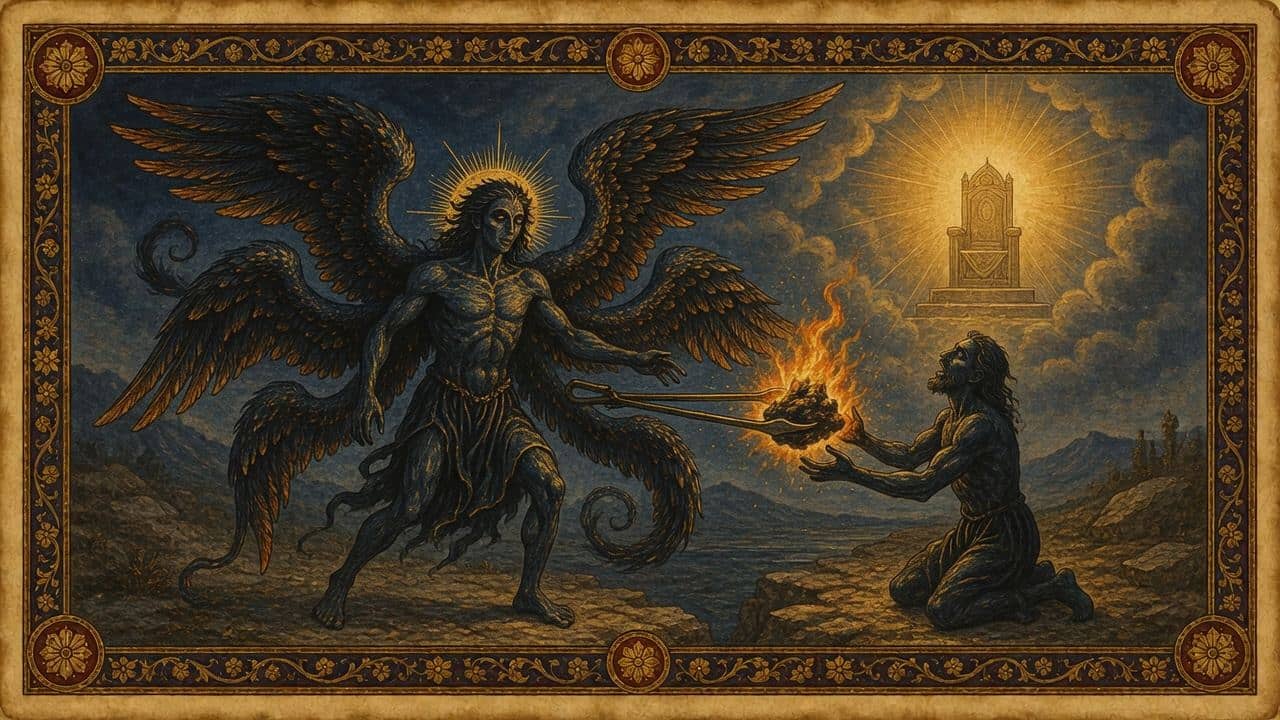
Isaiah sees the Lord on a throne, high and lifted up, with six-winged above him crying "Holy, holy, holy" — the same unceasing cry John hears from the four living creatures around the throne.
Isaiah 6:1–3Revelation 4:8bear God's throne — Ezekiel names his four living creatures as cherubim, David says God "rode on a cherub, and flew" — and they guard Eden's way with a flaming sword and overshadow the mercy seat with their wings.
Ezekiel 1:5Ezekiel 10:20Genesis 3:24Psalms 18:10Exodus 25:20Messengers sent. Armies gathered.
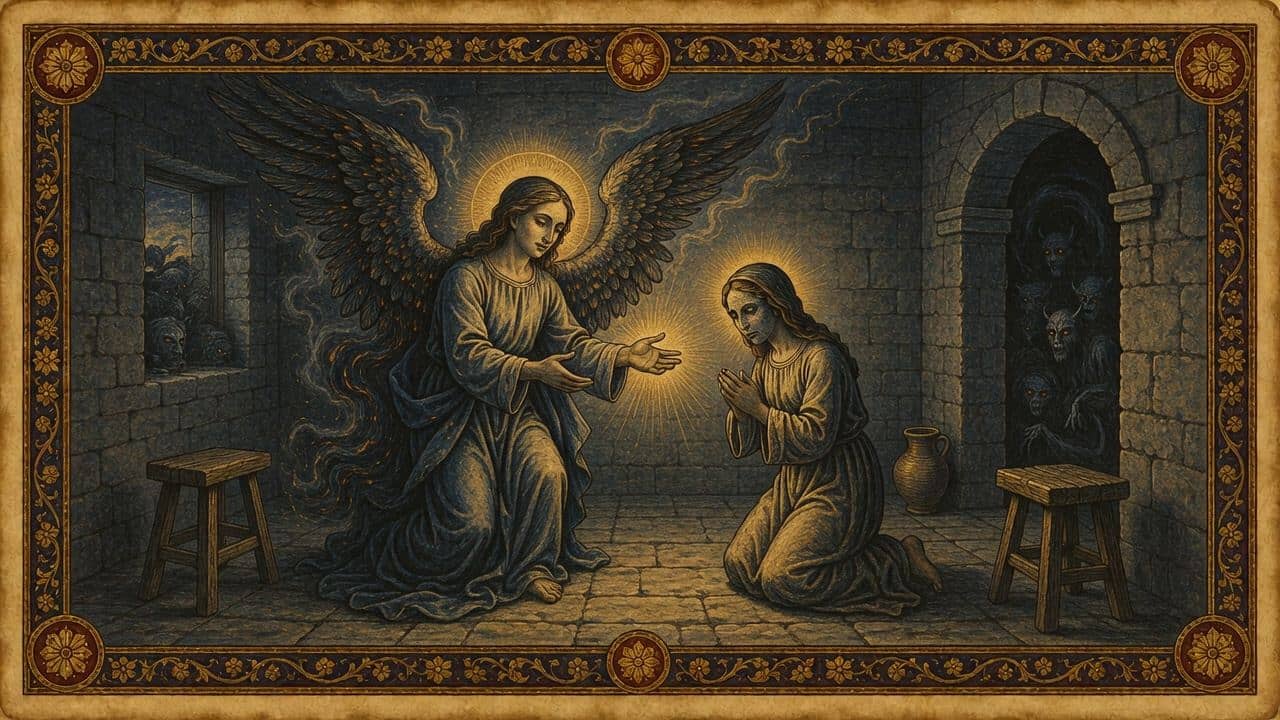
Scripture calls only Michael "the archangel" — "one of the chief princes" and "the great prince who stands for the children of your people" — and the Lord will descend with the voice of the archangel.
1 Thessalonians 4:16Jude 1:9Daniel 10:13Daniel 10:21Daniel 12:1The angels are "serving spirits, sent out to do service for the sake of those who will inherit salvation" — mighty ones who fulfill his word, armies who do his pleasure, a multitude of the heavenly army, innumerable multitudes.
Hebrews 1:14Psalms 103:20–21Luke 2:13Hebrews 12:22Where the unseen steps into human lives.
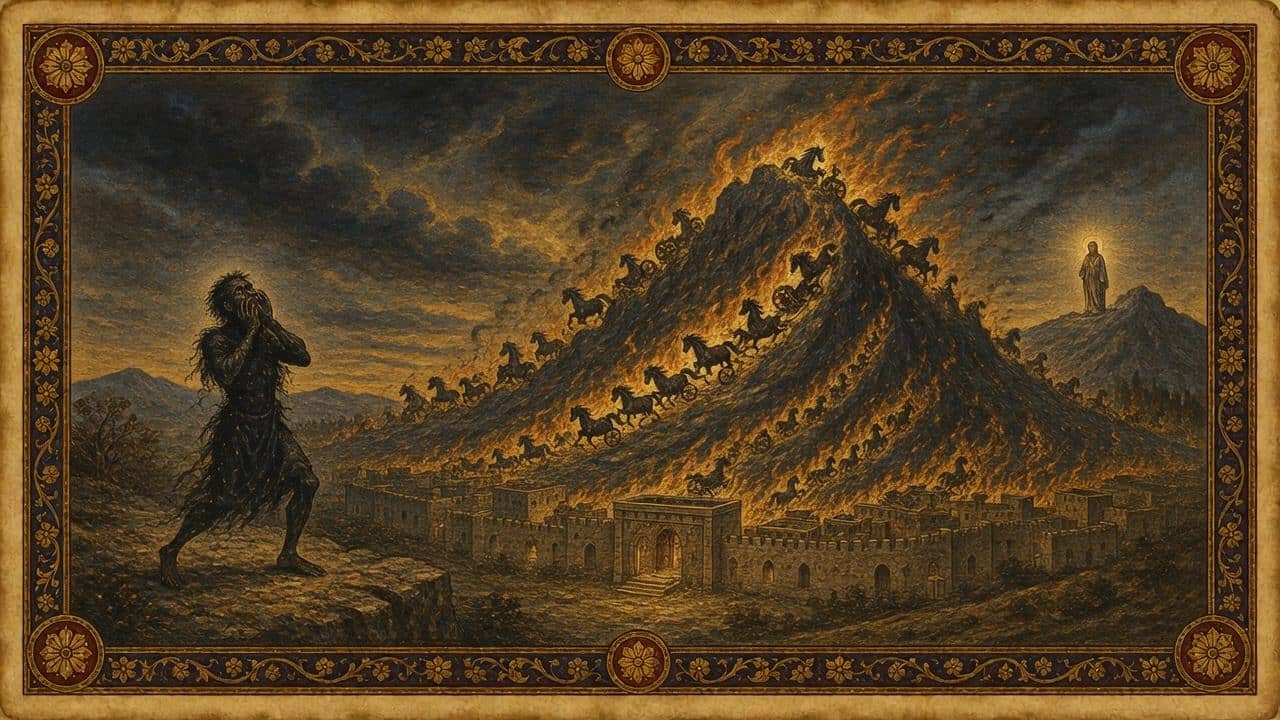
The earth stands between the unseen armies: when the servant's eyes are opened the mountain is full of horses and chariots of fire, strangers may be angels unawares, and the adversary walks around like a roaring lion.
2 Kings 6:17Hebrews 13:21 Peter 5:8Our wrestling is not against flesh and blood but against , powers, and the world's rulers of the darkness of this age — a "prince of the power of the air," a "god of this world" who blinds minds, and in Daniel a "prince of the kingdom of Persia" who withstands God's messenger twenty-one days.
Ephesians 6:12Ephesians 2:22 Corinthians 4:4Daniel 10:13The unclean spirits know who Jesus is and obey when he commands them out; a spirit gone out of a man passes through waterless places, and may return with seven others more evil than itself.
Mark 1:23–27Matthew 12:43–45The prison, the judgment, and the end.
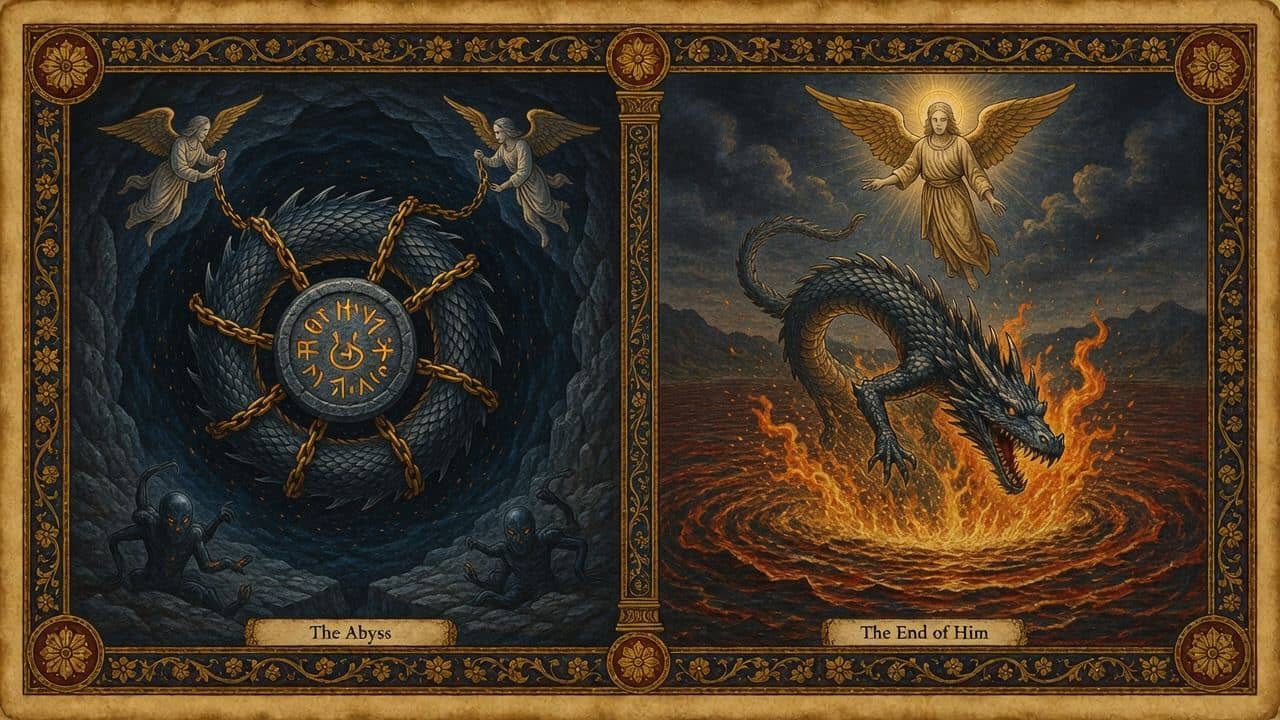
Demons beg Jesus not to send them into the abyss — a locked, smoking pit whose king angel is named in Hebrew and Apollyon in Greek — and the angels who sinned were "cast down to " (the WEB's rendering in 2 Peter), kept in everlasting bonds under darkness for the judgment of the great day.
Luke 8:31Revelation 9:1–2Revelation 9:112 Peter 2:4Jude 1:6The eternal fire was "prepared for the devil and his angels," and the devil who deceived the nations is thrown into the lake of fire and sulfur, tormented day and night forever and ever.
Matthew 25:41Revelation 20:10Choose your next question
Begin with the question you are actually asking. Every path keeps the passage, the interpretation, and the later tradition visibly distinct.
Who is like God?
“But Michael, the , when contending with the devil and arguing about the body of Moses, dared not bring against him an abusive condemnation, but said, “May the Lord rebuke you!”” — Jude 1:9
The only angel scripture calls archangel: one of the chief princes who stands for God's people against the princes of the nations, disputes with the devil over the body of Moses, and leads the war against the dragon in heaven.
Daniel 10:13Daniel 10:21Daniel 12:1Jude 1:9Revelation 12:7The war in heaven →God is my strength
“The angel answered him, “I am Gabriel, who stands in the presence of God. I was sent to speak to you and to bring you this good news.” — Luke 1:19
Stands in the presence of God and carries his announcements: he explains Daniel's visions and announces the births of John the Baptist and of Jesus.
Daniel 8:16Daniel 9:21Luke 1:19Luke 1:26The Annunciation, in the encounters →God heals
“I am , one of the seven holy angels which present the prayers of the saints and go in before the glory of the Holy One.”” — Tobit 12:15
Sent to heal Tobit's blindness and to free Sarah from the evil spirit Asmodaeus; he travels with Tobias unrecognized, then reveals himself as one of the seven who go in before the glory of the Holy One.
Tobit 3:17Tobit 5:4Tobit 12:15Raphael appears only in Tobit — in the Catholic, Orthodox, Armenian, and Ethiopian canons on this site; not in the Hebrew Bible or the Protestant Old Testament.
Raphael revealed, in the encounters →God is my light
“The angel who was sent to me, whose name was , gave me an answer,” — 2 Esdras 4:1
The angel sent to answer Ezra's questions about God's justice — and to humble him: he cannot comprehend even this world, let alone the way of the Most High.
2 Esdras 4:12 Esdras 5:20Uriel appears only in 2 Esdras, which sits outside most canons — printed as an appendix to the Latin and read in the Slavonic and Ethiopian traditions; hosted here in the WEB .
Friend of God — the same name Exodus gives Moses' father-in-law, Reuel.
“Then Raguel, one of the holy angels who was with me, answered me” — 1 Enoch 23:4
One of the seven holy angels who watch, set over the world of the luminaries — the lights of heaven. Two chapters later he is the angel at 's side explaining the fire in the west.
1 Enoch 20:41 Enoch 23:4Named only in 1 Enoch, canonical in the Ethiopian Orthodox church and outside every other ; hosted here in R. H. Charles's 1917 translation.
The sense is uncertain; the name is also read as Sariel or Suriel. A Sariêl stands in the list of the ' fallen leaders, and the text does not say whether the two are one.
“Saraqâêl, one of the holy angels, who is set over the spirits, who sin in the spirit.” — 1 Enoch 20:6
One of the seven holy angels who watch, set over the spirits who sin in the spirit. This single verse is all the book says of him.
1 Enoch 20:61 Enoch 6:7Named only in 1 Enoch, canonical in the Ethiopian Orthodox church and outside every other ; hosted here in R. H. Charles's 1917 translation.
Read as mercy of God or thunder of God. A Râmîêl also stands among the fallen leaders in chapter 6; the book does not connect them.
“Remiel, one of the holy angels, whom God set over those who rise.” — 1 Enoch 20:8
The last of the seven holy angels who watch, set over those who rise — the resurrection.
1 Enoch 20:81 Enoch 6:7Named only in 1 Enoch, canonical in the Ethiopian Orthodox church and outside every other ; hosted here in R. H. Charles's 1917 translation.
Face of God — the Hebrew Peniel, the name Jacob gave the place where he wrestled.
“and the fourth, who is set over the repentance unto hope of those who inherit eternal life, is named Phanuel.” — 1 Enoch 40:9
The fourth of the four presences in the Parables of Enoch, set over the repentance of those who inherit eternal life. He stands with Michael, Gabriel, and Raphael to cast the fallen into the furnace, and goes in and out of the house of the Head of Days.
1 Enoch 40:91 Enoch 54:61 Enoch 71:8–9Named only in 1 Enoch, canonical in the Ethiopian Orthodox church and outside every other ; hosted here in R. H. Charles's 1917 translation.
Hebrew mal'akh YHWH — "messenger of Yahweh" (WEB: "Yahweh's angel")
“She called the name of Yahweh who spoke to her, “You are a God who sees,” for she said, “Have I even stayed alive after seeing him?”” — Genesis 16:13
Appears to Hagar, to Moses in the burning bush, to Gideon, and to Manoah — and the text sometimes speaks of him as God himself: Hagar "called the name of Yahweh who spoke to her," and Manoah says "we have seen God." Traditions read this differently — a manifestation of God, the pre-incarnate Christ, or a messenger speaking wholly in his sender's name.
Genesis 16:7–13Exodus 3:2Judges 6:11–22Judges 13:21–22A special case, not a personal name: whether the Angel of the is a created angel or God appearing is an interpretive question the text itself leaves open.
Evidence before hierarchy
A named being is not the same thing as a complete angelic rank. A prophetic taunt is not automatically a biography of Satan. This room preserves the connections, but labels how much weight each one can carry.
Now on the day when God’s sons came to present themselves before , Satan also came among them.Job 1:6
Then Jesus was led up by the Spirit into the wilderness to be tempted by the devil.Matthew 4:1
“He has Beelzebul,” and, “By the prince of the demons he casts out the demons.”Mark 3:22
The great dragon was thrown down, the old serpent, he who is called the devil and Satan, the deceiver of the whole world.Revelation 12:9
the accuser of our brothers has been thrown down, who accuses them before our God day and night.Revelation 12:10
When he speaks a lie, he speaks on his own; for he is a liar, and the father of lies.John 8:44
He was a murderer from the beginning, and doesn’t stand in the truth, because there is no truth in him.John 8:44
according to the prince of the power of the air, the spirit who now works in the children of disobedience.Ephesians 2:2
in whom the god of this world has blinded the minds of the unbelieving2 Corinthians 4:4
They have over them as king the angel of the abyss. His name in Hebrew is “Abaddon”, but in Greek, he has the name “Apollyon”.Revelation 9:11
The tempter came and said to him, “If you are the Son of God, command that these stones become bread.”Matthew 4:3
Your adversary, the devil, walks around like a roaring lion, seeking whom he may devour.1 Peter 5:8
And no wonder, for even Satan masquerades as an angel of light.2 Corinthians 11:14
“See that you don’t despise one of these little ones, for I tell you that in heaven their angels always see the face of my Father who is in heaven.”
Jesus warns against despising children, grounding it in the reality that their angels continually behold the Father's face — the clearest text for individual angelic guardianship.
Matthew 18:10“Don’t forget to show hospitality to strangers, for in doing so, some have entertained angels without knowing it.”
The writer of Hebrews urges hospitality by recalling Abraham and Lot — both hosted angels without recognizing them at first (GEN 18–19).
Hebrews 13:2“For he will put his angels in charge of you, to guard you in all your ways.”
The psalmist promises divine protection through angelic guardianship — a verse the devil himself quotes back at Jesus in the wilderness (MAT 4:6; LUK 4:10–11).
Psalms 91:11“For in the resurrection they neither marry nor are given in marriage, but are like God’s angels in heaven.”
Jesus answers the : the resurrected state transcends marriage, resembling the angelic mode of existence — neither marrying nor dying.
Matthew 22:30“Don’t you know that we will judge angels? How much more, things that pertain to this life?”
Paul rebukes the Corinthians for taking disputes to pagan courts, reminding them that believers will participate in judging angels — a staggering dignity.
1 Corinthians 6:3“But even though we, or an angel from heaven, should preach to you any “good news” other than that which we preached to you, let him be cursed.”
Paul anchors gospel authority above any messenger — even an angel from heaven. The message, not the messenger, is the test.
Galatians 1:8“Aren’t they all serving spirits, sent out to do service for the sake of those who will inherit salvation?”
The writer's summary of what angels are for: sent out to serve those who will inherit salvation, not to be served.
Hebrews 1:14“Let all the angels of God worship him.”
In the argument that the Son is greater than the angels, the writer has all of them worship him.
Hebrews 1:6“For by him all things were created in the heavens and on the earth, visible things and invisible things, whether thrones or dominions or principalities or powers. All things have been created through him and for him.”
Thrones, dominions, principalities, powers — the invisible order is created, and created through Christ and for him. This is the verse behind “things visible and invisible”.
Colossians 1:16“Let no one rob you of your prize by self-abasement and worshiping of the angels, dwelling in the things which he has not seen, vainly puffed up by his fleshly mind,”
Paul warns Colossae against a religion of angel-worship and visions; the angels are not the prize.
Colossians 2:18“You must not do that! I am a fellow bondservant with you and with your brothers, the prophets, and with those who keep the words of this book. Worship God.”
John falls before the angel who showed him the visions and is stopped at once: the angel is a fellow servant, and worship belongs to God.
Revelation 22:8–9“who is at the right hand of God, having gone into heaven, angels and authorities and powers being made subject to him.”
Angels, authorities, and powers are placed under the risen Christ at God's right hand.
1 Peter 3:22“For our wrestling is not against flesh and blood, but against the principalities, against the powers, against the world’s rulers of the darkness of this age, and against the spiritual forces of wickedness in the heavenly places.”
Paul names the real opposition — principalities, powers, rulers of this darkness, spiritual forces in the heavenly places — and answers it with armor, not fascination.
Ephesians 6:12“You believe that God is one. You do well. The demons also believe—and shudder.”
James's test of faith: belief that God is one is something even the demons have, and it makes them shudder, not righteous.
James 2:19“But the Spirit says expressly that in later times some will fall away from the faith, paying attention to seducing spirits and doctrines of demons,”
Paul expects falling away in later times, and traces some false teaching to seducing spirits rather than to error alone.
1 Timothy 4:1“But I say that the things which the sacrifice, they sacrifice to demons and not to God, and I don’t desire that you would have fellowship with demons.”
Paul says of pagan sacrifice what Deuteronomy said of Israel's : it is offered to demons, and fellowship at that table is real.
1 Corinthians 10:20“Beloved, don’t believe every spirit, but test the spirits, whether they are of God, because many false prophets have gone out into the world.”
Not every spirit is to be believed; John gives the church a duty to test them, because false prophets have gone out.
1 John 4:1“Praise Yahweh, you angels of his, who are mighty in strength, who fulfill his word, obeying the voice of his word.”
The psalm calls on the angels to praise, and describes them by their obedience: they fulfill his word and listen for his voice.
Psalms 103:20“Yahweh’s angel encamps around those who fear him, and delivers them.”
David's psalm of deliverance: Yahweh's angel camps around those who fear him — protection as a settled presence, not a single rescue.
Psalms 34:7“Or do you think that I couldn’t ask my Father, and he would even now send me more than twelve of angels?”
At his arrest Jesus says he could ask for more than twelve legions of angels — the Roman word for thousands — and does not.
Matthew 26:53“Having stripped the principalities and the powers, he made a show of them openly, triumphing over them in it.”
Paul depicts Christ's cross as a public triumph over principalities and powers; translations differ on whether the verb is rendered ‘disarmed’ or ‘stripped.’
Colossians 2:15“that through death he might bring to nothing him who had the power of death, that is, the devil,”
The incarnation and death of Jesus targeted the root of demonic subjugation: destroying the devil who wielded the power of death, delivering those held lifelong in fear.
Hebrews 2:14“God presides in the great assembly. He judges among the gods.”
On a divine-council reading, Psalm 82 depicts God judging other elohim; other interpreters understand the figures as human rulers or judges.
Psalms 82:1After the names and visions
Angels are created servants, messengers, worshipers, and agents of judgment. Hostile spirits recognize Jesus’ identity and authority. The adversary’s story ends in defeat, not rivalry between equals.
Follow the encounters →The exact heavenly hierarchy, the full mechanics and timing of the fall, the identity of Genesis 6’s sons of God, and how every title for an unseen ruler relates to every other.
Weigh the fragments →Fixed nine-choir systems, elaborate angel and demon catalogues, and “Lucifer” as an unqualified personal name are later syntheses. They can be studied without being folded silently into the text.
See sources & method →The center of the record is not fascination with spirits. It is the authority of the one before whom every power is finally made subject.