The Soil and the Stone: Archaeological and Historical Evidence for Jesus
When we talk about history, we are essentially talking about footprints. Just like walking along a muddy path leaves an undeniable trail of where you have been, historical figures leave behind marks in the soil of time. Some footprints are written in ink (texts), some are carved in stone (inscriptions), and some are left behind in the clay and bone boxes of the ancient world.
For a long time, people viewed the story of Jesus of Nazareth as something existing only in the clouds of faith—spiritual, distant, and ungrounded. But if we want to pursue the truth, we have to look down at the soil. When we do, we find that the historical footprints of Jesus are deeper and clearer than many people assume.
Let's look at the empirical evidence. We will trace the footprints through three lines of inquiry: the testimonies of ancient writers who didn't even believe in Him, the inscriptions carved by Roman officials, and the physical relics pulled from the dust of Judea.
1. Footprints in Roman Ink: The Non-Believers' Testimony
If you want to know if someone was real, you don't just ask their best friends. You ask their critics and the neutral observers. In the first and second centuries, Roman historians had no interest in promoting a small, persecuted movement from the outskirts of the empire. Yet their writings give us some of the earliest non-Christian evidence that Jesus existed.
Tacitus: The Hard-Nosed Historian
Writing around 116 CE, the Roman senator and historian Tacitus recorded the Great Fire of Rome under Emperor Nero. In his Annals (Book 15, Section 44), he explains how Nero blamed the fire on a group called "Christians." He writes:
"Christus, the founder of the name, had undergone the death penalty in the reign of Tiberius, by sentence of the procurator Pontius Pilatus..."
Tacitus was no friend of Christianity; he called it a "mischievous superstition." Writing roughly eighty years after the crucifixion, this hostile witness still reports two things that line up with the Gospels: that Christus had been executed under Pontius Pilate during the reign of Tiberius. Most historians treat this as strong early corroboration that Jesus was a real, executed figure. (One wrinkle worth naming: Tacitus calls Pilate a "procurator," though Pilate's actual title was "prefect," and scholars debate whether Tacitus drew on independent records or simply repeated what Christians of his day believed.)
Josephus: The Jewish Scholar
Flavius Josephus, a Jewish historian writing in the late first century, wrote a massive work called Antiquities of the Jews. In it, he mentions Jesus twice. The most famous passage is called the Testimonium Flavianum. Almost everyone agrees that later Christian copyists embellished it with lines Josephus would not have written (such as "He was the Christ"). Most scholars hold that, stripped of those additions, the original core still described Jesus as a wise teacher who did "startling deeds," was crucified under Pilate, and kept a following—though a minority thinks the original wording is now unrecoverable. (Some researchers, such as Gary Goldberg, have also pointed to parallels with Luke's Emmaus narrative; that particular argument is a minority observation and is read in different ways.)
Other early writers add to the picture: Pliny the Younger (a Roman governor who, around 112 CE, described Christians "singing hymns to Christ as to a god") and Mara bar Serapion (a Syrian writer who refers to the execution of the Jews' "wise King," usually but not certainly read as Jesus). Within roughly a century of His life, Jesus and the movement around Him were being noticed in the wider non-Christian record—though several of these mentions are brief and allusive rather than detailed.
2. Footprints in Stone: The Epigraphical Evidence
Paper decays, but stone endures. Epigraphy—the study of ancient inscriptions—acts like a time capsule.
+-----------------------------------------------------------+
|                   THE INK AND THE STONE                   |
|                                                           |
|  [ Roman Ink (Texts) ]  ---> Attest Jesus' execution      |
|                              and His early followers.     |
|                                                           |
|  [ Delphi Inscription ] ---> Firm date for Paul           |
|                              (51-52 CE) -> early church.  |
|                                                           |
|  [ The Pilate Stone ]   ---> Confirm Pilate as a real     |
|                              Roman prefect of Judaea.     |
+-----------------------------------------------------------+
The Delphi Inscription (Gallio)
In Delphi, Greece, archaeologists found a series of stone fragments containing a letter from Emperor Claudius. Mentioned in this inscription is Lucius Junius Gallio, the Proconsul of Achaia.
Why it matters: The inscription allows historians to date Gallio's term precisely to 51–52 CE. The Connection: Acts 18:12 tells us that when Paul was in Corinth, he was brought before Gallio. This stone inscription acts as a historical anchor, locking the timeline of Paul's mission and letters into a narrow historical window. It shows the New Testament writers were working with real political figures and dates, not a vague invented past.The Pilate Stone
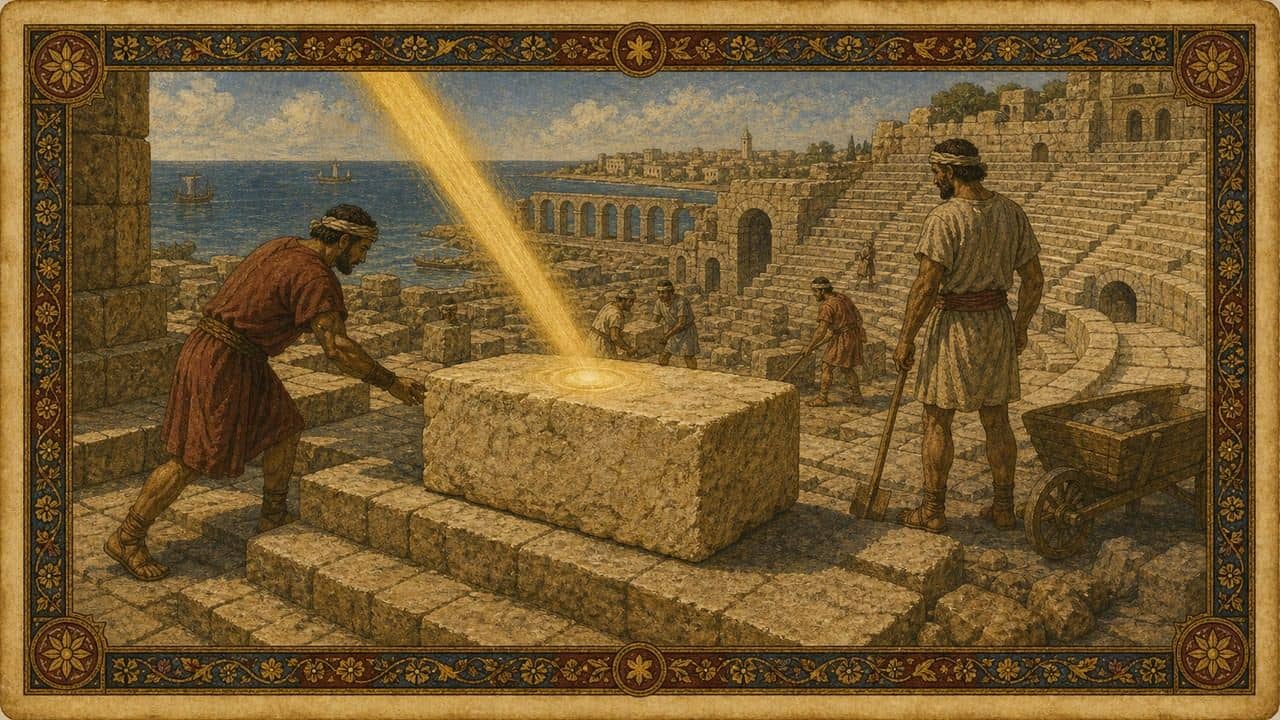
Pilate was already known from ancient writers—Josephus, Philo, and Tacitus all mention him—but for a long time no record from his own lifetime had survived. That changed in 1961 in the coastal city of Caesarea Maritima, where archaeologists found a limestone block, reused in a theater, bearing a fragmentary inscription. Its reconstructed text reads:
"[Ponti]us Pilatus, [Praef]ect of Judaea..."
The stone pinned down Pilate's exact title—prefect, the correct rank for Judaea's governor in his era (it was changed to procurator later, under Claudius). It is a building dedication that says nothing about Jesus or the trial, so it corroborates the Gospels' historical setting rather than their narrative. But it does confirm that the man who sentenced Jesus was a real Roman official, in the right place at the right time.
3. Footprints in Bone and Clay: Archaeological Discoveries
In the ancient Middle East, people practiced a two-step burial process. First, the body was laid in a cave. A year later, after the flesh decayed, the bones were gathered and placed in a stone box called an ossuary.
[Step 1: Cave Burial] -> 1 Year -> [Step 2: Ossuary Box]
The Caiaphas Ossuary
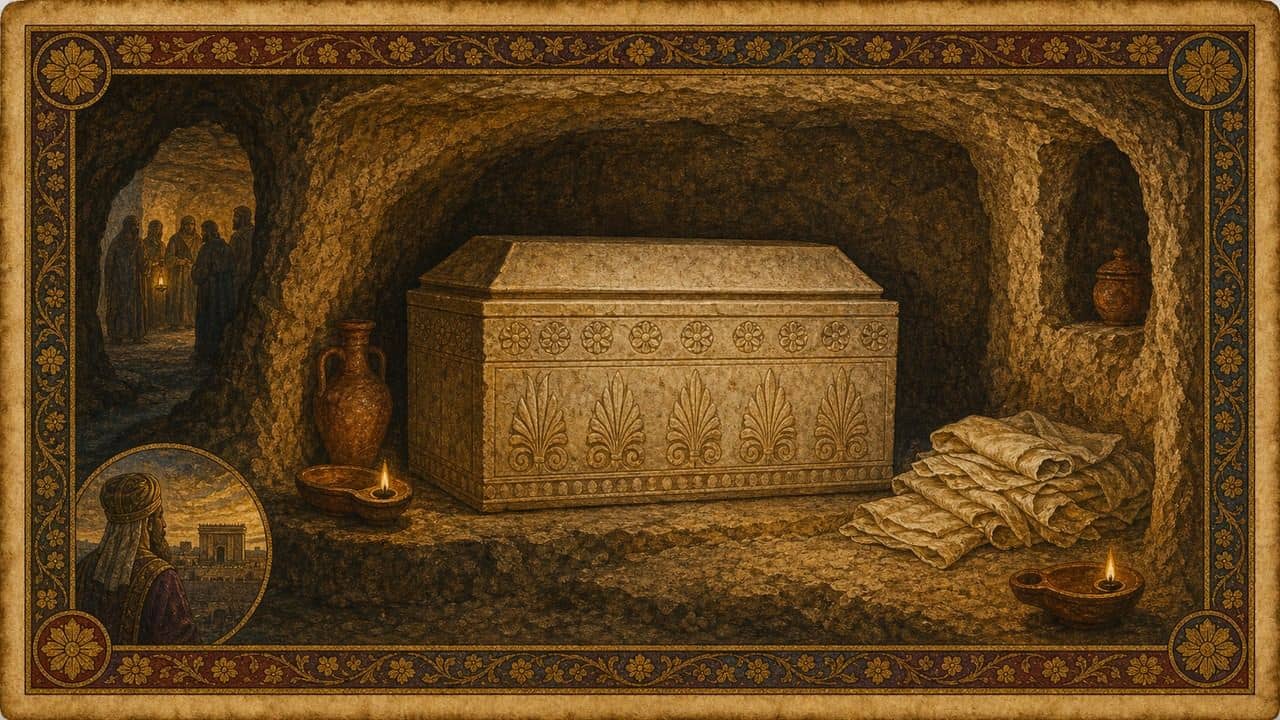
In 1990, workers building a water park in Jerusalem accidentally broke through the roof of a first-century burial cave. Inside, they found an exquisitely carved, ornate ossuary holding the bones of a man of about sixty. Incised on the side was the name Yehosef bar Kayafa (Joseph, son of Caiaphas). Many scholars identify this with Caiaphas, the high priest who presided over Jesus' trial—though the reading of the name and the identification are debated.
The James Ossuary
In 2002, a stone box surfaced with a shocking Aramaic inscription:
"Ya'akov bar Yosef akhui di Yeshua" (James, son of Joseph, brother of Jesus).
It is also one of the most disputed finds in biblical archaeology. Its owner, Oded Golan, was prosecuted for forgery; in 2012 an Israeli court acquitted him, ruling that the state had not proven the inscription was faked—but the judge stressed this did not prove it genuine, and the Israel Antiquities Authority still treats the inscription (or at least the "brother of Jesus" phrase) as a likely modern forgery. Some geologists (Amnon Rosenfeld, Howard Feldman, and Wolfgang Krumbein) argue that a natural patina runs inside the engraved letters, which would point to an ancient origin; other experts dispute that reading. And even if the inscription is genuine, the names James, Joseph, and Jesus were all extremely common—by one estimate, around twenty men in first-century Jerusalem could fit "James, son of Joseph, brother of Jesus"—so the box cannot be tied with certainty to Jesus of Nazareth.
The Giv'at ha-Mivtar Heel Bone
Skeptics once argued that the crucifixion stories were legends because the Roman norm was to leave crucified bodies unburied as a public deterrent.
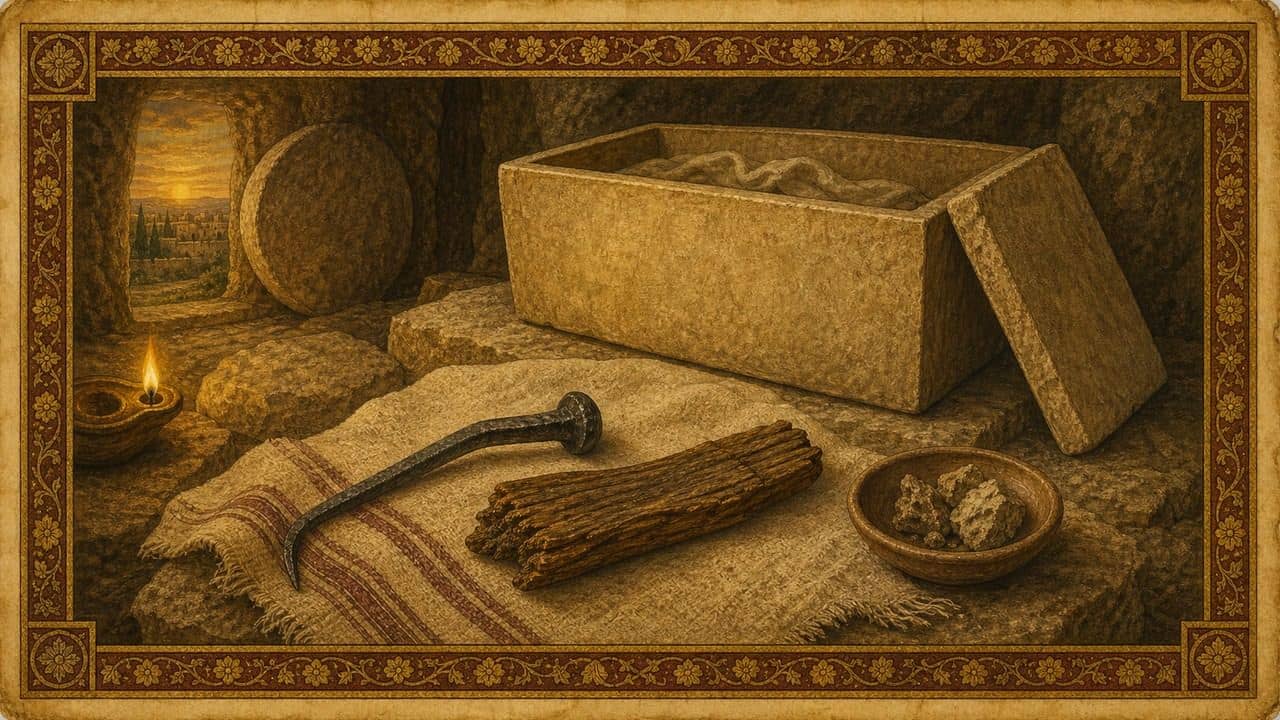
But in 1968, archaeologists in Jerusalem found the ossuary of a young man named Yehohanan from the first century. Still lodged in his heel bone was a bent iron nail with a fragment of olive wood—to this day the only widely accepted physical remains of a crucifixion victim from the Roman world. (An early 1970 reconstruction was significantly corrected by a 1985 reanalysis, so the details are read with care.) It shows that at least some crucified men in Roman Judea received proper burial in a family tomb—consistent with the Jewish custom of burying the dead before sunset (Deuteronomy 21:22–23) that lies behind the Gospel accounts of Jesus' burial.
4. The Shroud of Turin: A Contested Relic
Perhaps the most fascinating and debated relic is the Shroud of Turin—a linen cloth bearing a faint, photographic-negative image of a crucified man whose wounds echo the Gospel passion: scourging, a crown of thorns, a pierced side, and nails. It is worth treating carefully, because it is genuinely contested rather than settled either way.
       [Shroud: what is claimed vs. disputed]
       ├── Bloodstains (reported as blood by some; disputed by others)
       ├── 3D-like relief under a VP8 analyzer (suggestive, debated)
       └── No paint or dye per STURP (image formation unexplained)
In 1988, three independent laboratories radiocarbon-dated the Shroud to roughly 1260–1390 CE, pointing to a medieval origin. That remains the mainstream scientific result. Some researchers (notably Raymond Rogers) later argued that the sampled corner was a later repair, rewoven into the older cloth in a way that would throw off the date. This reweaving hypothesis is disputed and has not been accepted by most textile and radiocarbon specialists, though a few have called for fresh testing.
The image itself is still hard to explain, and here is where the honest picture is more careful than either the believer's or the skeptic's headline:
The image: The 1978 STURP team found no paint or dye and described the image as an extremely shallow discoloration of the topmost fibers. (The microscopist Walter McCrone dissented, reporting traces of iron-oxide and vermilion pigment.) How it formed is still unexplained; "scorched by a burst of light" is one hypothesis, not a settled finding—and a full-size image has also been reproduced with ordinary medieval materials. 3D information: Run through a VP8 image analyzer, the image yields a striking three-dimensional relief, suggesting its darkness varies with cloth-to-body distance. That is unusual for an artwork, though skeptics note that shaded images and bas-relief rubbing can also produce 3D-like results. Bloodstains: Some analysts report the stains as human blood with trauma markers (including a type-AB reading); these findings are contested, have not been independently replicated, and other researchers attribute the red areas to pigment.
Conclusion: Walking on Solid Ground
When we stack these lines of evidence together—the hostile Roman testimonies, the stone inscriptions of Gallio and Pilate, the bone boxes of Caiaphas and James, the crucifixion nail of Yehohanan, and the long-debated Shroud—a picture emerges. Some of these items are strong and direct; others are contextual or contested, and the essay has tried to say which is which.
We are not dealing with fairy tales told in a vacuum. We are dealing with a real man who walked on real dust, clashed with real politicians, and died a real, historically documented death under Pontius Pilate. Archaeology doesn't force anyone to believe, but it clears the weeds away so the path can be seen. When we dig into the history, we find that the soil of faith is rooted in real, documented ground.
 Synthesis Pillar I · Epistemological Convergence

