Sources & method
Source basis: Road steps, councils, faces, and claims cite their source records inline; dark chapters are stated beside bright ones. Sources
Browse this section
The councils.
Ten councils, from in 325 to Vatican II closing in 1965, mark where the Church gathered to settle what it believed — and where it broke. Read the "called by" line down the list and a second story appears: for the first seven, it is an emperor (or an empress) who summons the , not a pope; had not even been baptized when he convened the first one. By Trent, the summons comes from popes alone — the power to call the Church together had itself changed hands. Each room below holds two things: what was decided, and what that decision settled or split.
Explore councils by cityChoose a city to reach its first council below. Open each council for its decision, primary text, and consequence.
10 councils. Scan the date, place, and caller; open a council for its decision, primary text, and consequence.
First Council of Nicaea
Called by: Emperor Constantine IOpen decision + consequenceClose council
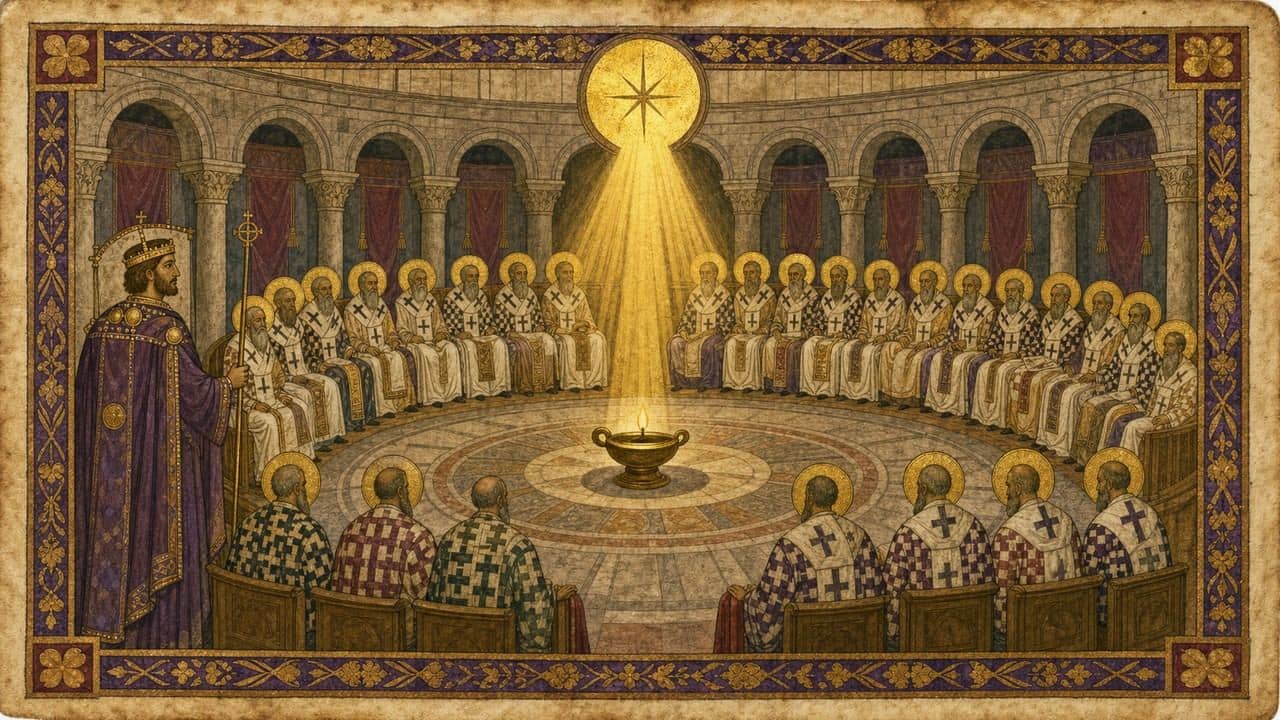
Called by: Emperor Constantine I
Summoned by Constantine — a still-unbaptized political ruler, with roughly 300 bishops present and the pope sending only legates — the council condemned 's teaching that the Son was a created being, affirming him instead as 'begotten, not made, being of one substance () with the Father.' It produced the original short creed of 325, ending simply 'And in the Holy Ghost,' and fixed a common method for dating Easter apart from the calendar.
“We believe in one God, the Father Almighty, Maker of all things visible and invisible. And in one Lord Jesus Christ, the Son of God, begotten of the Father [the only-begotten; that is, of the essence of the Father, God of God], Light of Light, very God of very God, begotten, not made, being of one substance (homoousion) with the Father; by whom all things were made [both in heaven and on earth]; who for us men, and for our salvation, came down and was incarnate and was made man; he suffered, and the third day he rose again, ascended into heaven; from thence he shall come to judge the quick and the dead. And in the Holy Ghost. But those who say: 'There was a time when he was not;' and 'He was not before he was made;' and 'He was made out of nothing,' or 'He is of another substance' or 'essence,' or 'The Son of God is created,' or 'changeable,' or 'alterable'—they are condemned by the holy catholic and apostolic Church.”
Consequence: The homoousios formula became the touchstone test of Trinitarian orthodoxy for essentially every church descending from this council — the controversy, unlike later splits, left no lasting separate communion — and , present only as a young , spent his life defending it against Arian resurgence.
Athanasius was here, as a young deacon →First Council of Constantinople
Called by: Emperor Theodosius IOpen decision + consequenceClose council
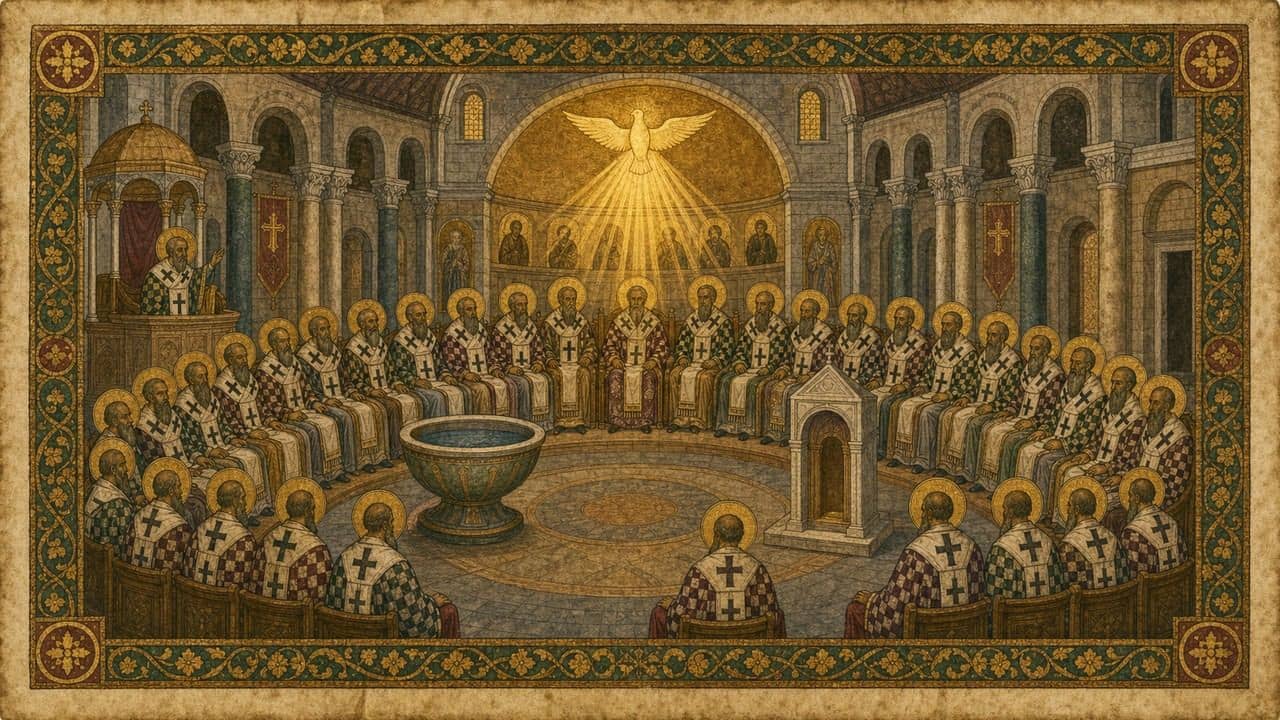
Called by: Emperor Theodosius I
The council expanded the 325 creed into the Niceno-Constantinopolitan form, adding articles on the Holy Spirit, the Church, baptism, and the resurrection, while condemning Apollinarianism and the teaching that the Spirit was a creature. Its 3 also ranked the Bishop of Constantinople second after Rome 'because Constantinople is New Rome' — a promotion for the imperial capital that Rome rejected as never submitted to the Apostolic See.
“And in the Holy Ghost, the Lord and Giver-of-Life, who proceedeth from the Father, who with the Father and the Son together is worshipped and glorified, who spake by the prophets. And [we believe] in one, holy, Catholic and Apostolic Church. We acknowledge one Baptism for the remission of sins, [and] we look for the resurrection of the dead and the life of the world to come. Amen.”
Consequence: The 381 wording is the creed nearly all Christians still recite — but the West's later Filioque addition to it, never accepted in the East, remains a live, unresolved dispute between the Catholic and Protestant West and the Eastern Orthodox churches to this day.
Council of Ephesus
Called by: Emperor Theodosius II, who issued the imperial summons (sacra) calling the metropolitan bishops to assembleOpen decision + consequenceClose council
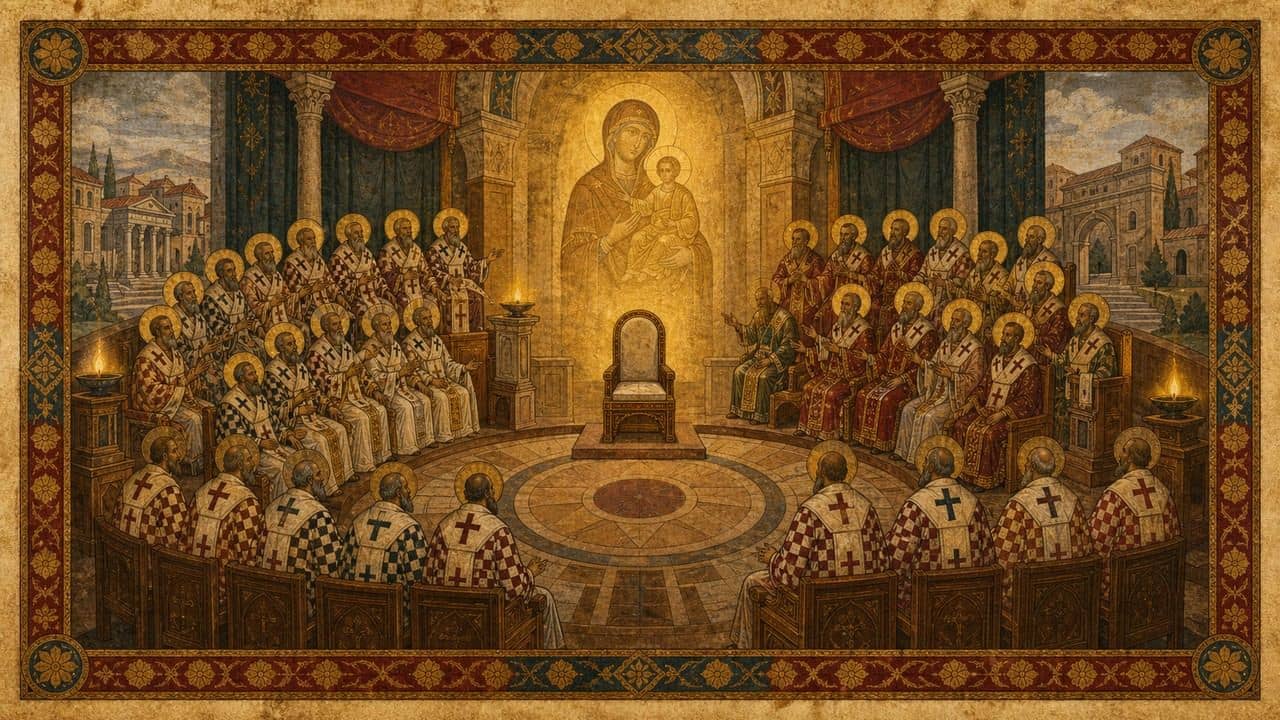
Called by: Emperor Theodosius II, who issued the imperial summons (sacra) calling the metropolitan bishops to assemble
Opened by Cyril of before the bishops sympathetic to Nestorius had even arrived, the council deposed Nestorius, of Constantinople, for teaching — in the reading his opponents pressed — that Christ was two loosely joined persons, and declared him 'excluded from the episcopal dignity, and from all priestly communion.' The later recovery of Nestorius's own Bazaar of Heracleides has left scholars divided over whether he held anything so stark, or was condemned in a caricature — much as the Oriental Orthodox were. It endorsed Cyril's letters affirming Mary as Theotokos, 'Mother of God,' against Nestorius's preferred 'Mother of Christ.'
“our Lord Jesus Christ, whom he has blasphemed, decrees by the holy Synod that Nestorius be excluded from the episcopal dignity, and from all priestly communion”
Consequence: The Church of the East — the Persian tradition, later called Nestorian — did not accept the condemnation, and 431 is the root of its separation from the rest of the church, the first branch to split off on this site's own family tree.
The Church of the East, on the tree →Council of Chalcedon
Called by: Emperor Marcian (with Empress Pulcheria), October 8 – November 1, 451Open decision + consequenceClose council
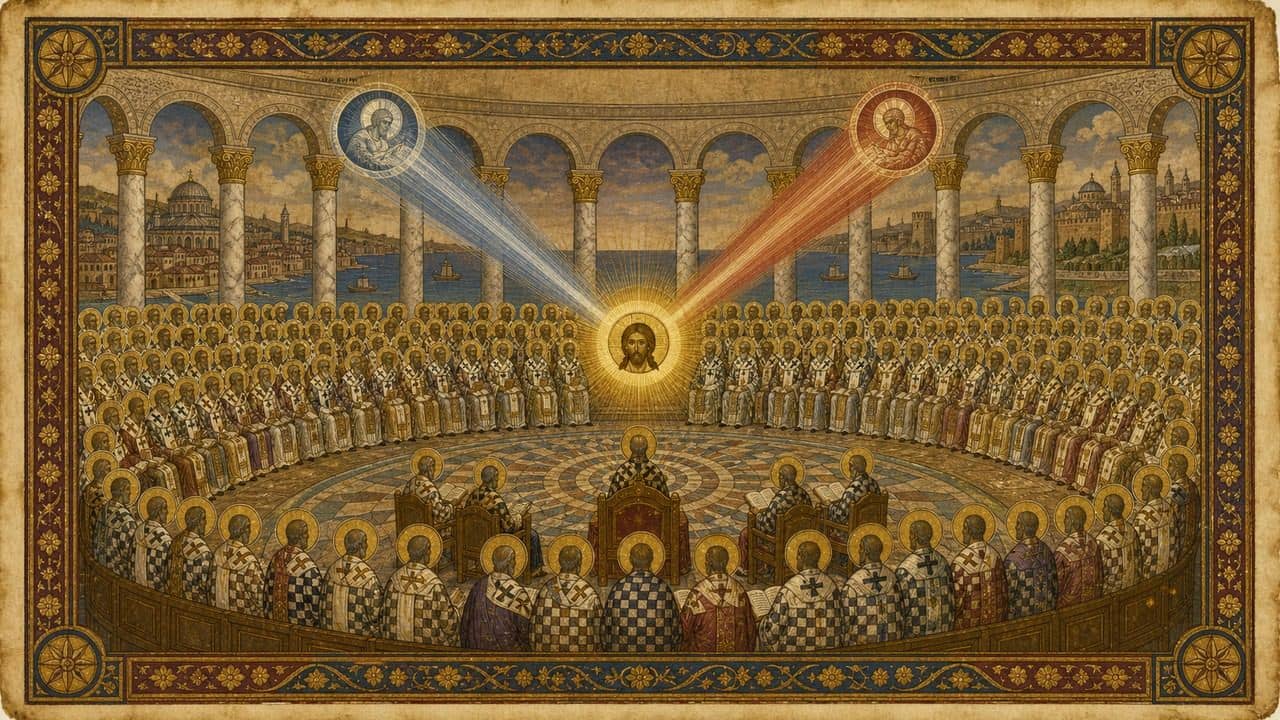
Called by: Emperor Marcian (with Empress Pulcheria), October 8 – November 1, 451
Convened by Emperor Marcian with some 500-520 bishops — the largest of the first seven councils — it condemned Eutyches's one-fused-nature teaching, deposed Dioscorus of Alexandria for the 449 'Robber Synod,' and issued the Chalcedonian Definition: one Person in two natures, 'unconfusedly, immutably, indivisibly, inseparably.' It presented this as continuous with Nicaea, Constantinople, Cyril, and Pope Leo's Tome — not as anything new.
“This one and the same Jesus Christ, the only-begotten Son [of God] must be confessed to be in two natures, unconfusedly, immutably, indivisibly, inseparably [united], and that without the distinction of natures being taken away by such union, but rather the peculiar property of each nature being preserved and being united in one Person and subsistence, not separated or divided into two persons, but one and the same Son and only-begotten, God the Word, our Lord Jesus Christ.”
Consequence: The Oriental Orthodox communions — Coptic, Ethiopian, Eritrean, Armenian Apostolic, Syriac — rejected the two-natures formula and separated from both Rome and the Byzantine churches in 451, a split still unhealed, though twentieth-century dialogues found substantial underlying agreement on Christ's person.
The Oriental Orthodox, on the tree →Second Council of Constantinople
Called by: Emperor Justinian IOpen decision + consequenceClose council
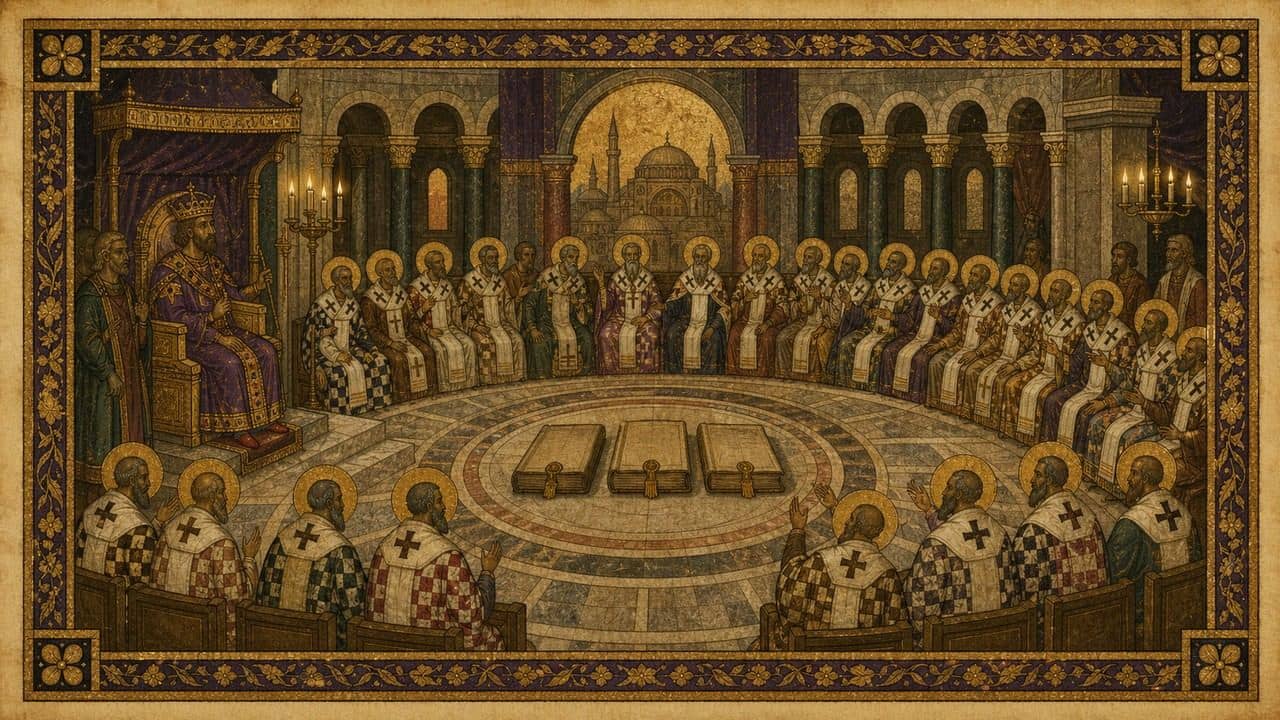
Called by: Emperor Justinian I
Justinian summoned this council to condemn the 'Three Chapters' — the person and writings of Theodore of Mopsuestia, certain writings of Theodoret, and Ibas's letter to Mari — as tending toward Nestorianism, hoping to win the anti-Chalcedonian churches back while still upholding . Pope Vigilius, brought to Constantinople and held there against his will, resisted and then capitulated under imperial pressure in December 553.
“If anyone shall not confess that the nature or essence of the Father, of the Son, and of the Holy Ghost is one, as also the force and the power; [if anyone does not confess] a consubstantial Trinity, one Godhead to be worshipped in three subsistences or Persons: let him be .”
Consequence: The reconciliation failed on both sides: the Oriental Orthodox did not return to communion, and in the West the condemnation itself touched off the decades-long Three Chapters among Latin churches, notably Aquileia and Milan.
Third Council of Constantinople
Called by: Emperor Constantine IVOpen decision + consequenceClose council
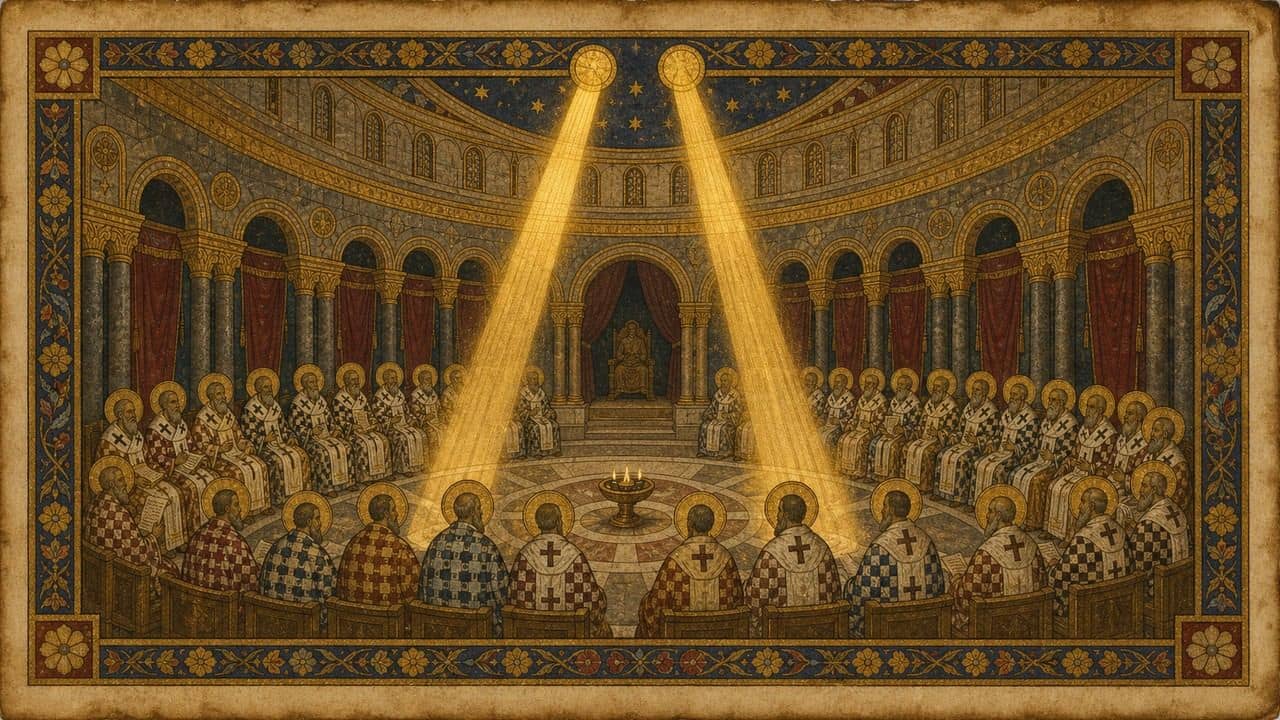
Called by: Emperor Constantine IV
Meeting in the domed hall of the imperial palace under Constantine IV, the council condemned Monothelitism — the politically convenient teaching that Christ had only one will — affirming two natural wills and operations, the human in perfect, non-resistant subjection to the divine. It anathematized by name several past patriarchs and, remarkably, Pope Honorius I of Rome, 'because of what we found written by him to Sergius.'
“"...defining all this we likewise declare that in him are two natural wills and two natural operations indivisibly, inconvertibly, inseparably, inconfusedly, according to the teaching of the holy Fathers. And these two natural wills are not contrary the one to the other (God forbid!) as the impious heretics assert, but his human will follows and that not as resisting and reluctant, but rather as subject to his divine and omnipotent will... Wherefore we confess two wills and two operations, concurring most fitly in him for the salvation of the human race." And, from the Sentence against the Monothelites (Session XIII): "And with these we define that there shall be expelled from the holy Church of God and anathematized Honorius who was some time Pope of Old Rome, because of what we found written by him to Sergius, that in all respects he followed his view and confirmed his impious doctrines."”
Consequence: Pope Leo II confirmed the decrees — anathema against his predecessor included — and no schism followed, but the condemnation of a dead pope as a heretic became a standing complication cited centuries later in the debates over papal infallibility at Vatican I.
Second Council of Nicaea
Called by: Empress Irene of Athens, acting as regent for her minor son, Emperor Constantine VI — working with Patriarch Tarasius of Constantinople, who directed the proceedingsOpen decision + consequenceClose council
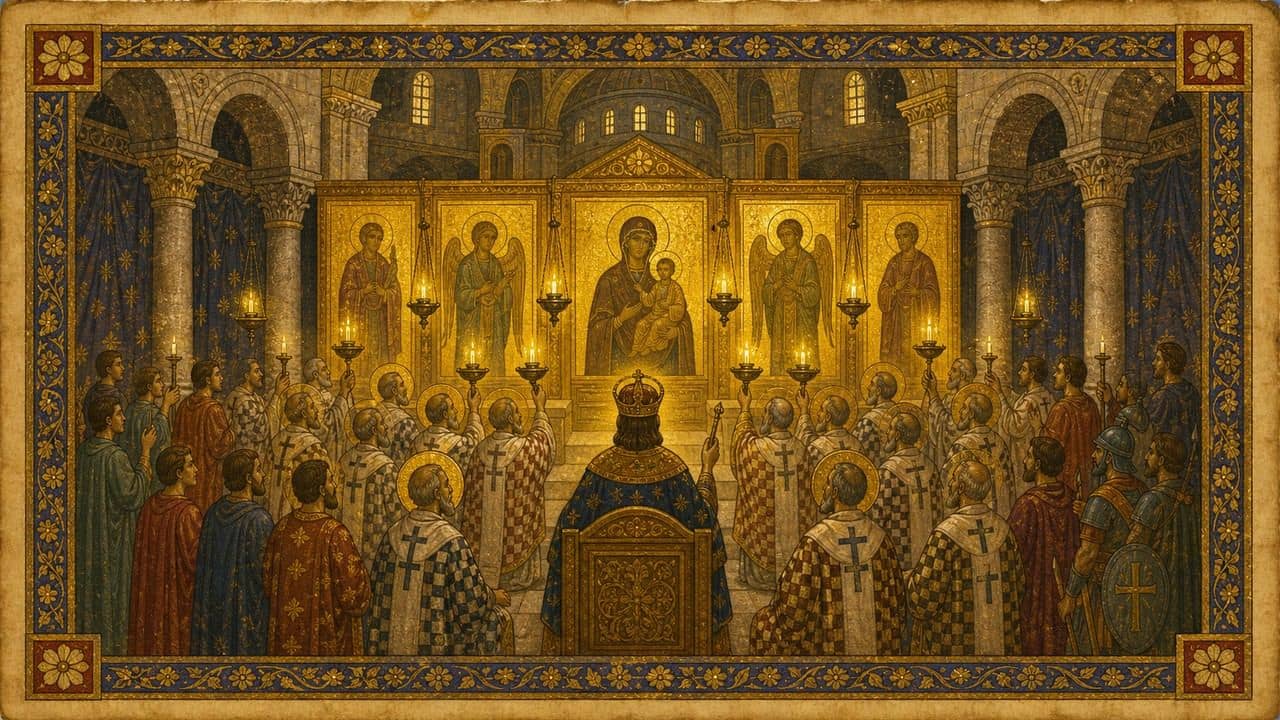
Called by: Empress Irene of Athens, acting as regent for her minor son, Emperor Constantine VI — working with Patriarch Tarasius of Constantinople, who directed the proceedings
Convened by Empress Irene, regent for her minor son — a woman ruler calling an council — with roughly 350 bishops and Patriarch Tarasius presiding, it restored the veneration of icons, ending the first period of Byzantine Iconoclasm. Its Definition drew a firm line between latria, worship due to God alone, and the honorable reverence given to images, which passes through the object to the person depicted, not to the wood or paint.
“For the honour which is paid to the image passes on to that which the image represents, and he who reveres the image reveres in it the subject represented.”
Consequence: This ruling is why Orthodox and Catholic churches still venerate icons today — though the settlement did not hold at first: a second Iconoclasm began around 815 and was only reversed in 843, when Empress Theodora restored the icons in what the East still commemorates as the 'Triumph of Orthodoxy.'
Council of Trent
Called by: Pope Paul III — convoked the council (opened 13 December 1545); its later periods were overseen by Pope Julius III (1551–1552) and Pope Pius IV (1562–1563). Unlike the early ecumenical councils, which were summoned by emperors, Trent was called and carried forward entirely by popes — the shift from imperial to papal convocation of councils is complete by this point.Open decision + consequenceClose council
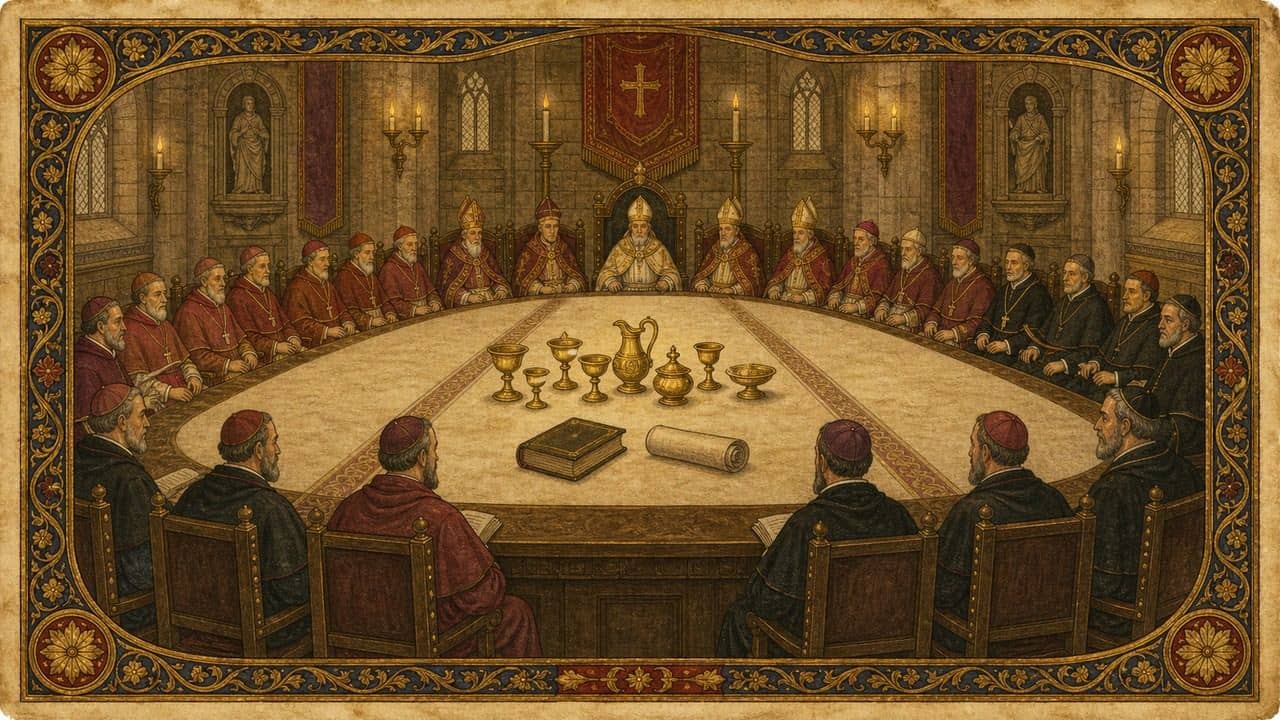
Called by: Pope Paul III — convoked the council (opened 13 December 1545); its later periods were overseen by Pope Julius III (1551–1552) and Pope Pius IV (1562–1563). Unlike the early ecumenical councils, which were summoned by emperors, Trent was called and carried forward entirely by popes — the shift from imperial to papal convocation of councils is complete by this point.
Called and carried forward entirely by popes — the shift from imperial to papal convocation complete — Trent met in 25 sessions across 18 years as the Catholic answer to the Reformation. It declared Scripture and unwritten Tradition received with equal reverence, fixed the Catholic canon including the books, reaffirmed justification by faith and works together against Luther's sola fide, upheld all seven sacraments, required every diocese to found a seminary, and kept indulgences while ordering their abuses corrected.
“"[The synod] following the examples of the orthodox fathers, receives and venerates with equal affection of piety, and reverence, all the books both of the Old and of the New Testament,—seeing that one God is the author of both,—as also the said traditions, as well those appertaining to faith as to morals, as having been dictated, either by Christ's own word of mouth, or by the Holy Ghost, and preserved by a continuous succession in the Catholic Church."”
Consequence: Trent's canon of 46 Old Testament and 27 New Testament books became fixed and binding — closing a question the early Church had never settled by universal council — and its 'equal reverence' for Tradition set Catholic teaching against sola scriptura in a division never since resolved.
First Vatican Council
Called by: Pope Pius IXOpen decision + consequenceClose council
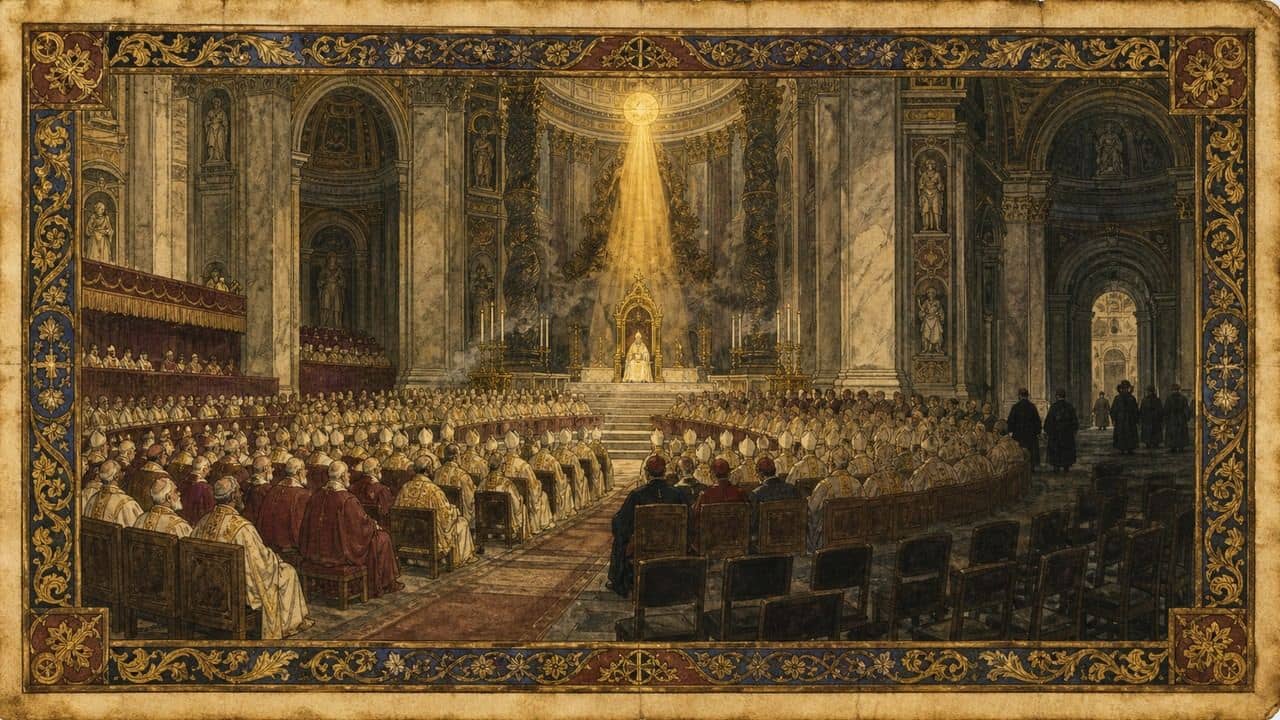
Called by: Pope Pius IX
The council's fourth session adopted Pastor Aeternus on July 18, 1870, defining papal infallibility: the pope speaking ex cathedra on faith or morals is preserved from error, his definitions 'irreformable of themselves, and not from the consent of the Church.' The vote was 533 to 2 — but some 55-60 opposed bishops left Rome rather than vote no, and two months later Italian troops seized the city, ending the council so abruptly it was not formally closed until 1960.
“Therefore faithfully adhering to the tradition received from the beginning of the Christian faith, for the glory of God our Saviour, the exaltation of the Catholic religion, and the salvation of Christian people, the sacred Council approving, we teach and define that it is a dogma divinely revealed: that the Roman Pontiff, when he speaks ex cathedra, that is, when in discharge of the office of pastor and doctor of all Christians, by virtue of his supreme Apostolic authority, he defines a doctrine regarding faith or morals to be held by the universal Church, by the divine assistance promised to him in blessed Peter, is possessed of that infallibility with which the divine Redeemer willed that his Church should be endowed for defining doctrine regarding faith or morals; and that therefore such definitions of the Roman Pontiff are irreformable of themselves, and not from the consent of the Church.”
Consequence: The definition remains a principal point of division from the Orthodox and Protestant churches, and a group of mainly German-speaking Catholics — including Döllinger, excommunicated in 1871 — refused it and split off to form the Old Catholic Church.
Second Vatican Council
Called by: Pope John XXIII, who first announced his intention to convene the council on 25 January 1959 at the Basilica of St. Paul Outside the Walls; he died on 3 June 1963 partway through the council, and his successor, Pope Paul VI, continued and closed itOpen decision + consequenceClose council
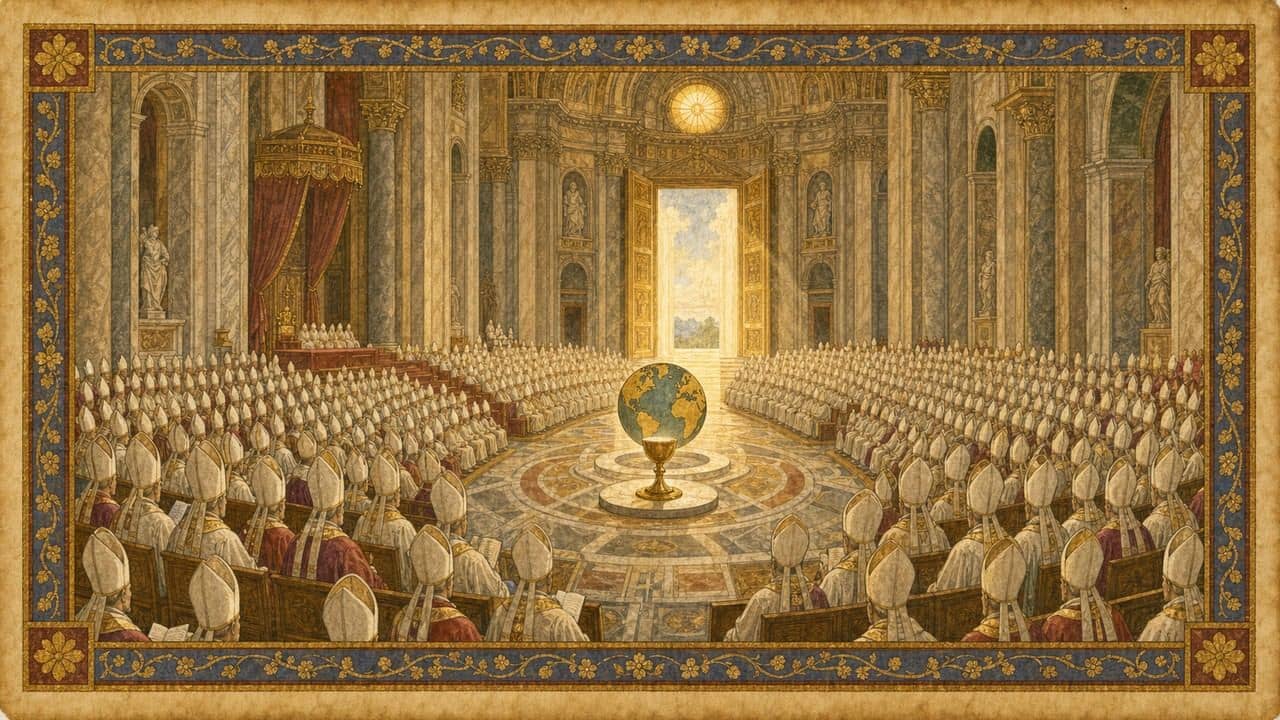
Called by: Pope John XXIII, who first announced his intention to convene the council on 25 January 1959 at the Basilica of St. Paul Outside the Walls; he died on 3 June 1963 partway through the council, and his successor, Pope Paul VI, continued and closed it
Framed by John XXIII as aggiornamento — 'bringing up to date' — Vatican II produced sixteen documents across four sessions from 1962 to 1965. It opened the Mass to vernacular languages and restored communion under both kinds to the laity; Nostra Aetate repudiated the charge of collective Jewish guilt for Christ's death and condemned antisemitism; and Gaudium et Spes became the first pastoral constitution by an ecumenical council to address the whole world directly.
Consequence: The vernacular liturgy and Nostra Aetate reshaped everyday Catholic worship and Catholic-Jewish relations worldwide — effects still in force — while a traditionalist minority, notably the Society of St. Pius X, rejected the reforms, an internal split that continues.