Sources & method
Source basis: Road steps, councils, faces, and claims cite their source records inline; dark chapters are stated beside bright ones. Sources
Browse this section
The giants.
The church's greatest teachers were not its cleanest men. This room takes the giants the faith genuinely owes — and sets what each one gave beside what the record shows he did. No flattery, no demolition: the gift and the fault, side by side, every claim sourced.
“But we have this treasure in clay vessels, that the exceeding greatness of the power may be of God and not from ourselves.”Scripture set this pattern long before church history repeated it. David took a man's wife and then his life; Peter denied his Lord three times; Paul held the coats at Stephen's stoning — and the record keeps every one of those days on the page. In the Bible's own telling, a saint was never a sinless man.
9 records. Scan each gift and fault, then open the full evidence only where you want to go deeper.
The first systematic theologianOrigen of Alexandria
c. 185–253 · Alexandria; Caesarea, PalestineThe giftThe pioneering biblical scholar and system-builder who taught the church to read Scripture for its spiritual depth.The faultSpeculations a later council condemned as heresy, and a self-mutilation the ancient sources report but modern scholars dispute.Open the full recordClose the full record
“Each one, then, ought to describe in his own mind, in a threefold manner, the understanding of the divine letters.”
The gift
The most learned Christian of his age. Origen produced the Hexapla — the Old Testament laid out in six parallel columns — commentaries across nearly the whole Bible, and On First Principles, the first attempt at a complete Christian theology. He taught the church to read Scripture on three levels — literal, moral, and spiritual — and answered the philosopher Celsus with philosophy of his own. Almost every later Greek Father writes in his debt.
The fault
His boldness ran ahead of the church that came after him. On First Principles floated ideas — the pre-existence of souls, the final restoration of all things, a subordinate Son — that the Second Council of Constantinople anathematized in 553, three centuries after his death. And reports that as a young teacher Origen castrated himself, taking Christ's words about eunuchs 'for the kingdom' with fatal literalness. Modern scholars doubt the story — Origen's own later commentary rejects reading that verse literally at all — but either the deed or its long shadow sits on the record.
Eusebius, Ecclesiastical History VI.8 (NPNF2, on the self-mutilation)
Defender of the Nicene creedAthanasius of Alexandria
c. 296/298–373 · Alexandria, EgyptThe giftHeld the Nicene line through five exiles and left the earliest surviving list matching today's twenty-seven-book New Testament.The faultViolence by his Alexandrian faction is documented, while the hostile sources leave his personal responsibility disputed.Open the full recordClose the full record
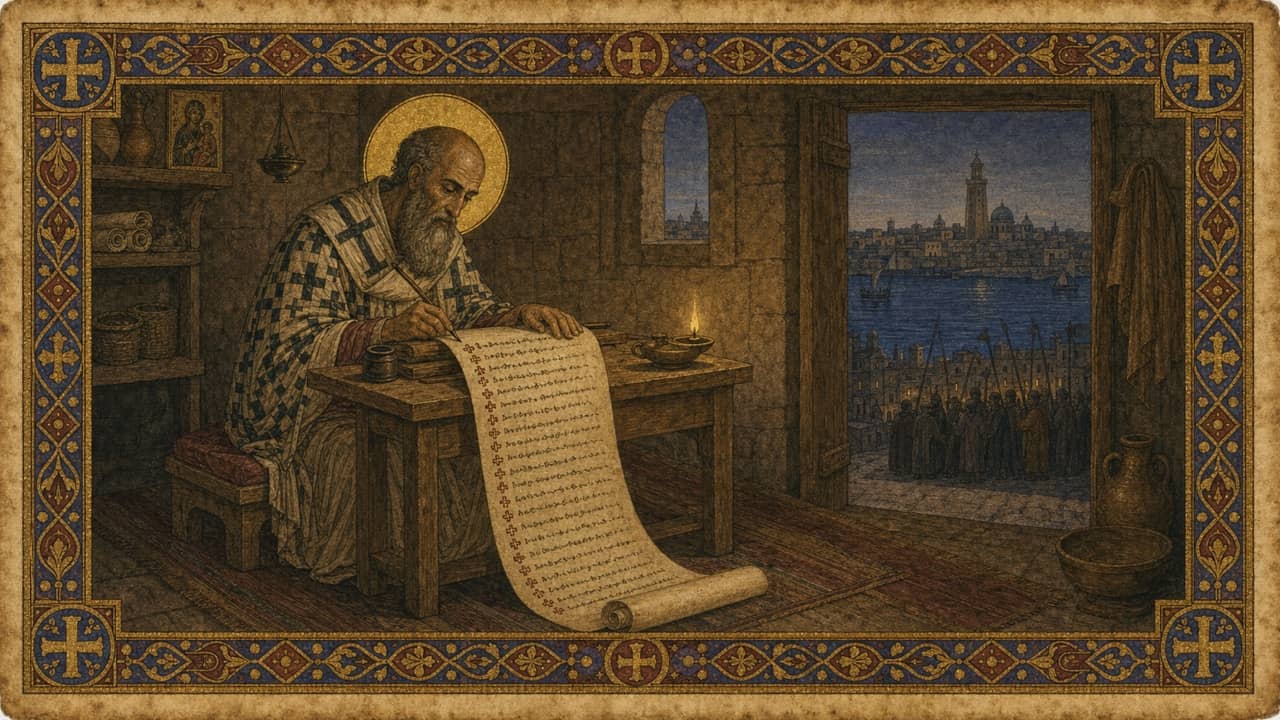
“For He was made man that we might be made God; and He manifested Himself by a body that we might receive the idea of the unseen Father; and He endured the insolence of men that we might inherit immortality.”
The gift
of for forty-five years — seventeen of them spent in five exiles under four emperors — in the century's long war over whether the Son is fully God. He held the line through all of it. His Easter letter of 367 also carries the earliest known list of exactly the twenty-seven books of the New Testament.
The fault
The fight was not clean. A letter from 335 (P.Lond. VI 1914, published by H. I. Bell in 1924) alleges that his partisans, soldiers alongside them, beat a hostel-keeper for lodging Melitian monks and imprisoned five others; a synod at Tyre deposed him the same year on charges that included violence. The sources are partisan — the letter is a hostile witness, and scholars still argue over 's personal hand — but that faction violence marked his Alexandria is documented either way, and this page will not pretend otherwise.
P.Lond. VI 1914, in Bell, Jews and Christians in Egypt (1924) · BMCR review of Hauben, Studies on the Melitian Schism
The West's teacher of graceAugustine of Hippo
354–430 · Thagaste and Hippo Regius, Roman North AfricaThe giftShaped Western teaching on grace, spiritual autobiography, and how Christians read history.The faultSent away his longtime partner to pursue marriage and later defended state coercion of fellow Christians, though he opposed executions.Open the full recordClose the full record
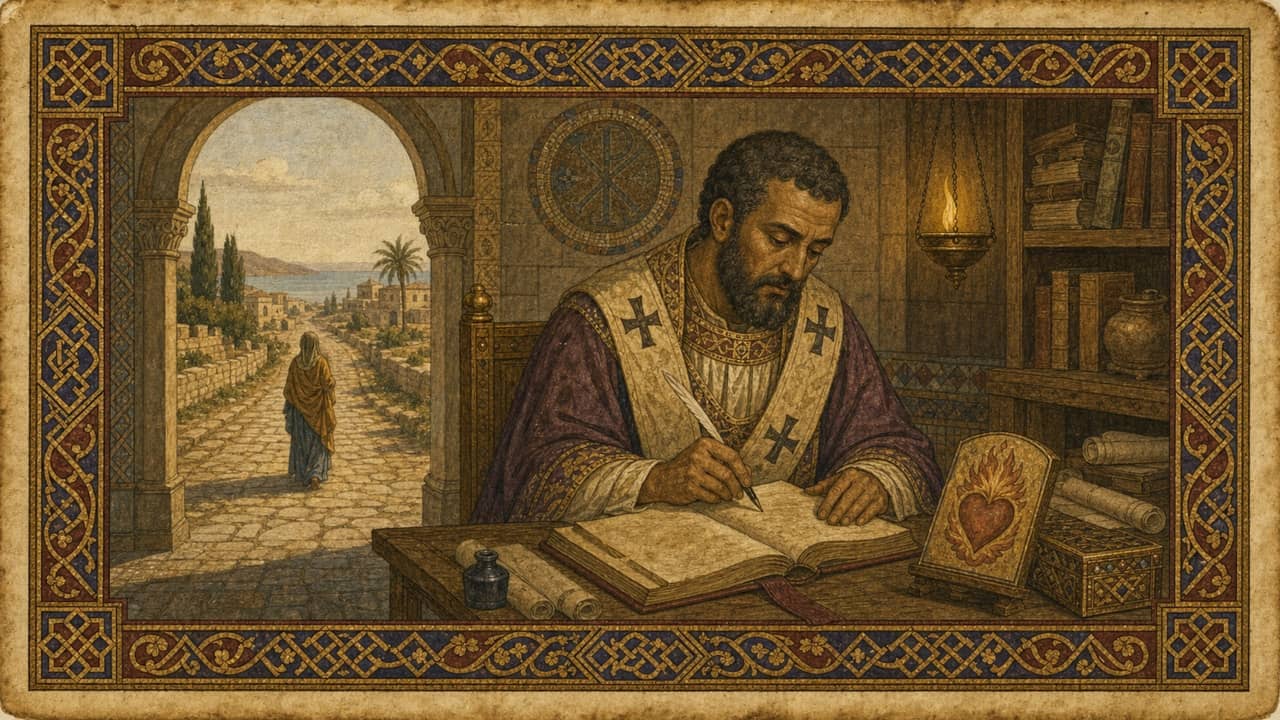
“Meanwhile my sins were being multiplied, and my mistress being torn from my side as an impediment to my marriage, my heart, which clave to her, was racked, and wounded, and bleeding. And she went back to Africa, making a vow unto You never to know another man, leaving with me my natural son by her.”
The gift
Bishop of Hippo Regius. His Confessions is the foundational work of Christian spiritual autobiography; his City of God taught a collapsing empire how to read history; his answer to Pelagius gave the West its doctrine of grace — the church still calls him the Doctor of Grace.
The fault
The honesty of the Confessions covers a real wound: the woman he had lived with since his student days, the mother of his son, was sent away as an impediment when a respectable marriage was arranged — and he kept the grief on the page. Later, as bishop, he defended imperial coercion of the Donatist schismatics, reading 'compel them to come in' (Luke 14:23) as warrant for state force against fellow Christians — a documented shift from his earlier persuasion-alone position. He did, at the same time, repeatedly beg Roman officials to spare even violent Donatists from execution.
Letter 93, to Vincentius (408), §5 · Letter 100, to Donatus — his plea against executions
The architect of the one ChristCyril of Alexandria
c. 376–444 · Alexandria, EgyptThe giftSecured the Theotokos and the unity of the one Christ at Ephesus — the Christology every later council built on.The faultHis patriarchate's mob violence stained Alexandria, and the murder of Hypatia fell within the climate he inflamed.Open the full recordClose the full record
“Confessing the Word to be made one with the flesh according to substance, we adore one Son and Lord Jesus Christ.”
The gift
of Alexandria and the driving force of the Council of (431), where he won for Mary the title Theotokos — 'God-bearer' — and, against Nestorius, the confession of one Christ rather than two loosely joined persons. His insistence that the eternal Word himself was born, suffered, and rose became the grammar of all later Christology: both and Constantinople II reasoned from his letters. Few theologians shaped what the church would say about Christ more permanently.
The fault
He fought like a man determined to win. His patriarchate drove Alexandria's Jews from the city after street bloodshed, feuded openly with the imperial prefect Orestes, and honoured as a a monk who had wounded Orestes in an assault. In 415 a Christian mob led by a reader named Peter seized the philosopher and mathematician Hypatia and murdered her in a church. The near-contemporary historian Socrates lays the deed on the mob, not Cyril's own hand — while recording that it 'brought no small opprobrium upon Cyril and the Alexandrian church.' His personal order is not attested and is still debated; the climate he inflamed is not.
Socrates Scholasticus, Ecclesiastical History VII.13–15 (NPNF2)
The theologian of the iconsJohn of Damascus
c. 675–749 · Damascus; Mar Saba, near JerusalemThe giftGave the church its defense of sacred images and the great synthesis of Greek patristic theology.The faultHis refutation of Islam cast it as a Christian heresy and seeded centuries of contemptuous polemic.Open the full recordClose the full record
“The honour given to the image passes over to the prototype.”
The gift
Writing from a monastery under the new Islamic caliphate, John left the church two lasting gifts. Against the emperor's campaign to destroy religious images, his treatises On the Divine Images argued that because God had taken visible flesh he could be depicted — and that the honour paid an icon passes to the one it shows, not to the wood; the Second Council of (787) vindicated him. His Fount of Knowledge, above all An Exact Exposition of the Orthodox Faith, gathered the Greek Fathers into the systematic summary the Christian East has taught ever since.
The fault
The same Fount of Knowledge closes with a catalogue of , and its long final chapter turns on 'the heresy of the Ishmaelites' — Islam. Living among Muslims, John cast their faith not as a rival religion but as a Christian deviation, mocked the Prophet as a false teacher, and set a pattern that a thousand years of Western polemic would follow. It is learned work, and it is a poisoned root: much of the church's later contempt for Islam traces back through this chapter.
Daniel J. Sahas, John of Damascus on Islam: The 'Heresy of the Ishmaelites' (Brill, 1972)
Faith and reason in one frameThomas Aquinas
1225–1274 · Roccasecca; died at Fossanova, ItalyThe giftBuilt Christianity's most influential synthesis of faith and reason in the unfinished Summa Theologica.The faultArgued that obstinate heretics could be handed to secular authority for execution.Open the full recordClose the full record
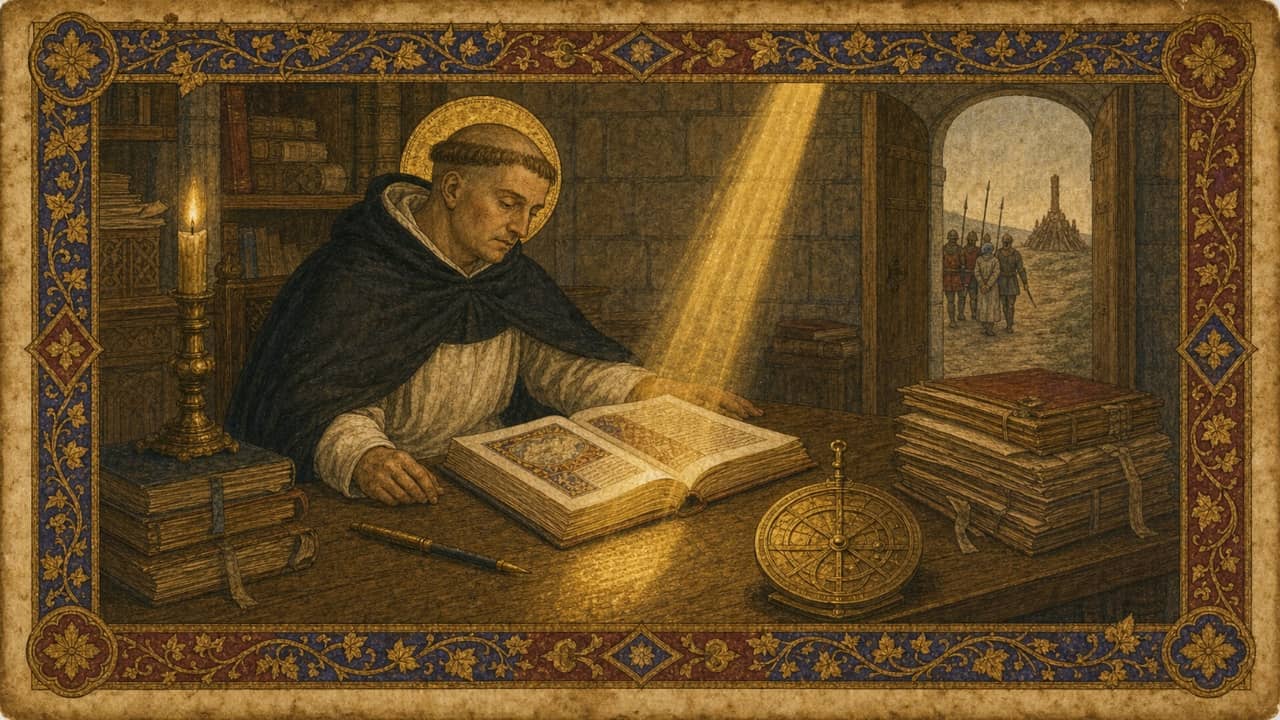
“The love which is based on this communication, is : wherefore it is evident that charity is the friendship of man for God.”
The gift
A Dominican friar who set out to hold faith and reason together. His Summa Theologica — left unfinished at his death — gave the church its most complete map of doctrine, from the Five Ways it argues for God's existence to charity defined as friendship between man and God. On 6 December 1273 he stopped writing altogether, telling his companion Reginald — by reported testimony later entered in the canonization records, as the 1912 Catholic Encyclopedia renders it — 'I can do no more. Such secrets have been revealed to me that all I have written now appears to be of little value.' Tradition keeps the Latin of it: palea — straw. That account is secondhand testimony, not his own pen, and is flagged as such.
The fault
The same Summa teaches, in cold syllogism, that obstinate heretics 'deserve not only to be separated from the Church by excommunication, but also to be severed from the world by death' (II-II, Q.11, A.3), the relapsed to be delivered to the secular tribunal. This was no abstraction: for centuries the inquisitorial process handed the condemned to exactly that death, and the church's greatest mind had supplied the argument.
Summa Theologica II-II, Q.11, A.3 (Dominican Fathers, 1920) · Catholic Encyclopedia: Inquisition
The Reformation's igniterMartin Luther
1483–1546 · Eisleben and Wittenberg, SaxonyThe giftIgnited the Reformation, preached justification by faith, and put a complete German Bible into ordinary hands.The faultPublished a program of anti-Jewish persecution and urged princes to crush the rebelling peasants without mercy.Open the full recordClose the full record
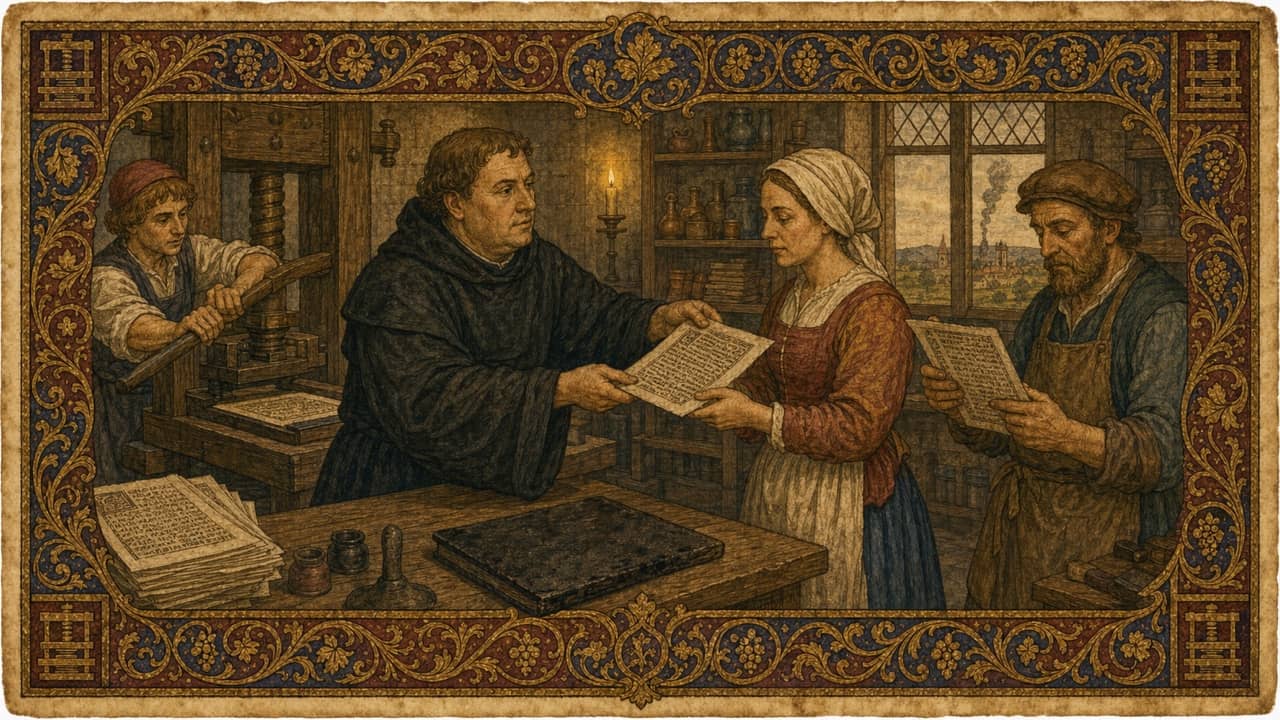
“Our Lord and Master Jesus Christ, when He said Poenitentiam agite, willed that the whole life of believers should be repentance.”
The gift
An Augustinian monk whose Ninety-five Theses — sent to his archbishop on 31 October 1517, and, by a later account, posted on the Wittenberg church door — cracked the Western church open. He preached that the sinner is justified by faith alone, not by purchased pardons — and then put the Bible itself into his people's hands, the German New Testament in 1522 and the complete Bible in 1534.
The fault
In 1523 he wrote 'That Jesus Christ Was Born a Jew,' urging Christians to deal gently with the Jewish people. Twenty years later, in 'On the Jews and Their Lies' (1543), he urged that be set on fire, Jewish homes razed, prayer books and Talmuds seized, rabbis forbidden to teach on pain of death, safe-conduct revoked, wealth confiscated, and the young put to forced labor — with expulsion held in reserve. Four centuries on, Julius Streicher invoked the book in his own defense at Nuremberg. Luther's own heirs have formally repudiated it — the Missouri Synod in 1983, the ELCA in 1994. And in 1525 he had already urged the princes to cut down the rebelling peasants without mercy.
Von den Juden und ihren Lügen (1543) — excerpts, CCJR · Nuremberg proceedings, 29 April 1946 (Streicher) · LCMS 1983 Resolution 3-09 · ELCA Declaration to the Jewish Community (1994)
The systematizer of GenevaJohn Calvin
1509–1564 · Noyon, France; GenevaThe giftSystematized Reformed theology in the Institutes and helped shape the Presbyterian and Reformed family of churches.The faultDrove the prosecution of Michael Servetus and defended his execution afterward.Open the full recordClose the full record
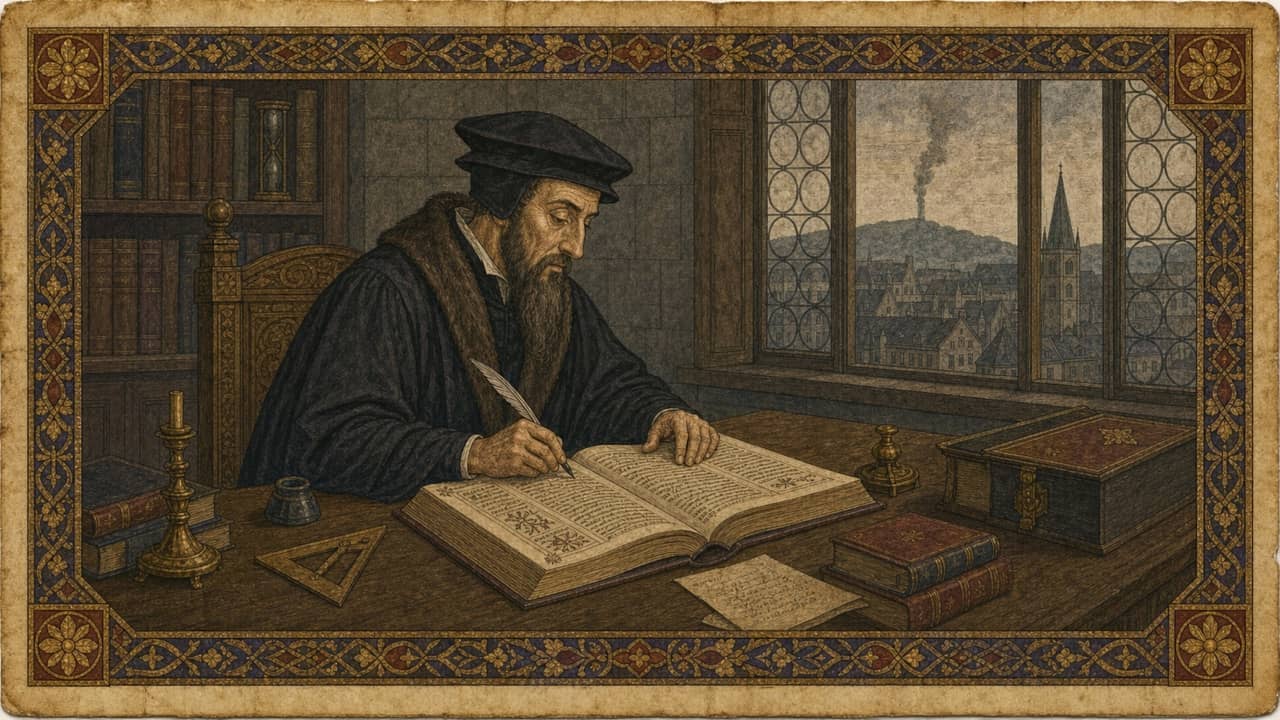
“Our wisdom, in so far as it ought to be deemed true and solid Wisdom, consists almost entirely of two parts: the knowledge of God and of ourselves.”
The gift
A French exile whose Institutes of the Christian Religion — first published in 1536, grown five times larger by its final edition of 1559 — became and remained the standard of belief for the churches known as Reformed. John Knox carried its discipline home to Scotland's ; the Reformed and Presbyterian family of churches is rooted in this one book and the city that lived under it.
The fault
Seven years before Michael Servetus stood trial in Geneva, Calvin wrote to Farel that if the man ever came, 'I shall never permit him to depart alive, provided my authority be of any avail.' Servetus came. Calvin drove the prosecution, and on 27 October 1553 the antitrinitarian physician was burned at Champel. Calvin had asked for the sword instead of the fire — a mercy of method, not of outcome — and was overruled; the next year he defended the execution in print. Melanchthon wrote to tell him the magistrates had done right. That is context, not excuse.
Schaff, History of the Christian Church VIII, §136–155 (Servetus) · Letters of John Calvin, Vol. II (Bonnet, 1857), Letter CLIV · 1911 Encyclopaedia Britannica: Servetus, Michael
The century's church dogmaticianKarl Barth
1886–1968 · Safenwil, Bonn, BaselThe giftReoriented twentieth-century Protestant theology and helped author the Barmen resistance to a church captured by Nazism.The faultSustained a romantic relationship with his collaborator inside the family home despite the lasting harm it caused.Open the full recordClose the full record
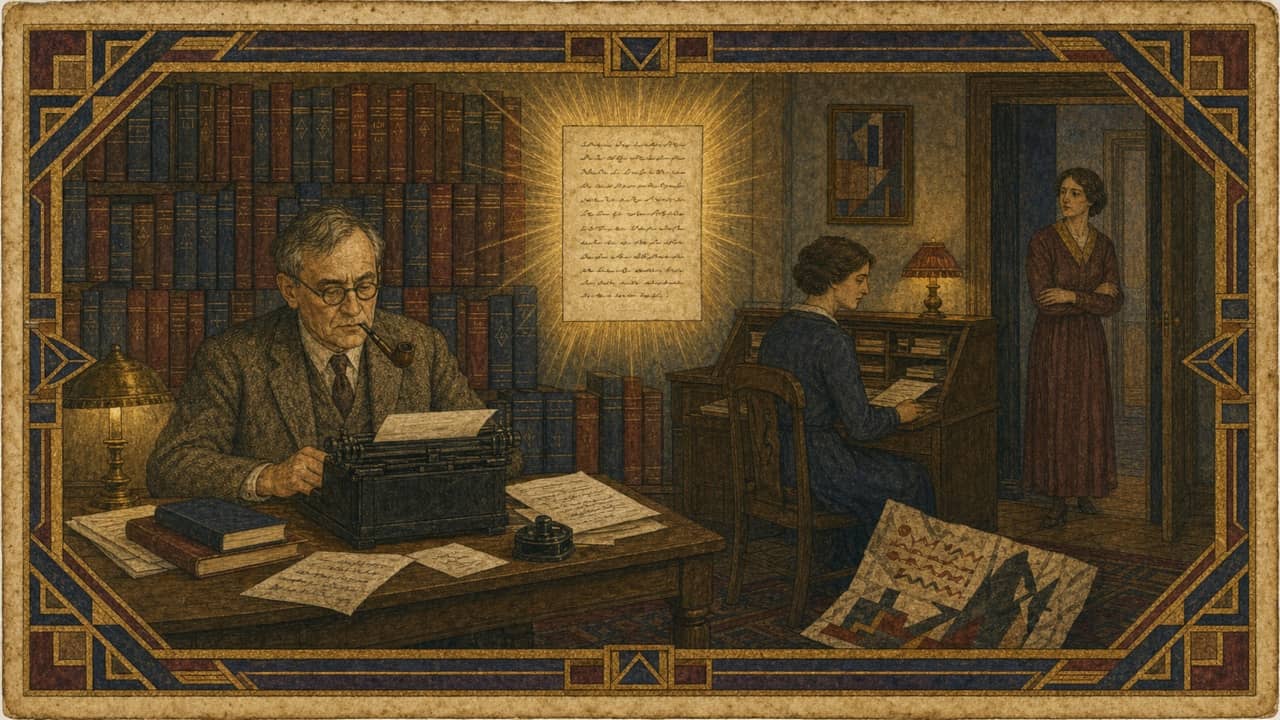
The gift
A Swiss pastor whose rewritten commentary on Romans (1922) broke the spell of liberal Protestant theology. His Church Dogmatics ran past nine thousand pages and was still unfinished when he died. When the 'German Christians' fused the church with Hitler's movement, Barth was the principal author of the Barmen Declaration (May 1934) that refused the fusion — and in 1935 he was removed from his Bonn professorship after refusing to swear the loyalty oath to Hitler without qualification.
The fault
In 1929 his secretary and theological collaborator, Charlotte von Kirschbaum, moved into the Barth family home and remained for roughly three decades. The published correspondence, and the scholarship built on it, establish that the relationship was romantic. His wife Nelly lived in the same house throughout; she at one point proposed divorce, and Barth's own later letters — as cited by his biographer — show he knew the arrangement caused his family deep and lasting harm that he never resolved. His words stay under copyright, so none are quoted here; the record stands without them.
Tietz, 'Karl Barth and Charlotte von Kirschbaum,' Theology Today 74/2 (2017) · Tietz, Karl Barth: A Life in Conflict (OUP, 2021) · Galli, 'What to Make of Karl Barth's Steadfast Adultery,' Christianity Today (2017)
None of this is flattery, and none of it is demolition — it is the record. The same church that received the creed from these hands reads in its own scriptures that David took a man’s wife and then his life, that Peter denied his Lord three times, and that Paul held the coats at a stoning. The treasure was never the vessel. The people behind each culture of the church are in the faces; what they decided together is in the councils.