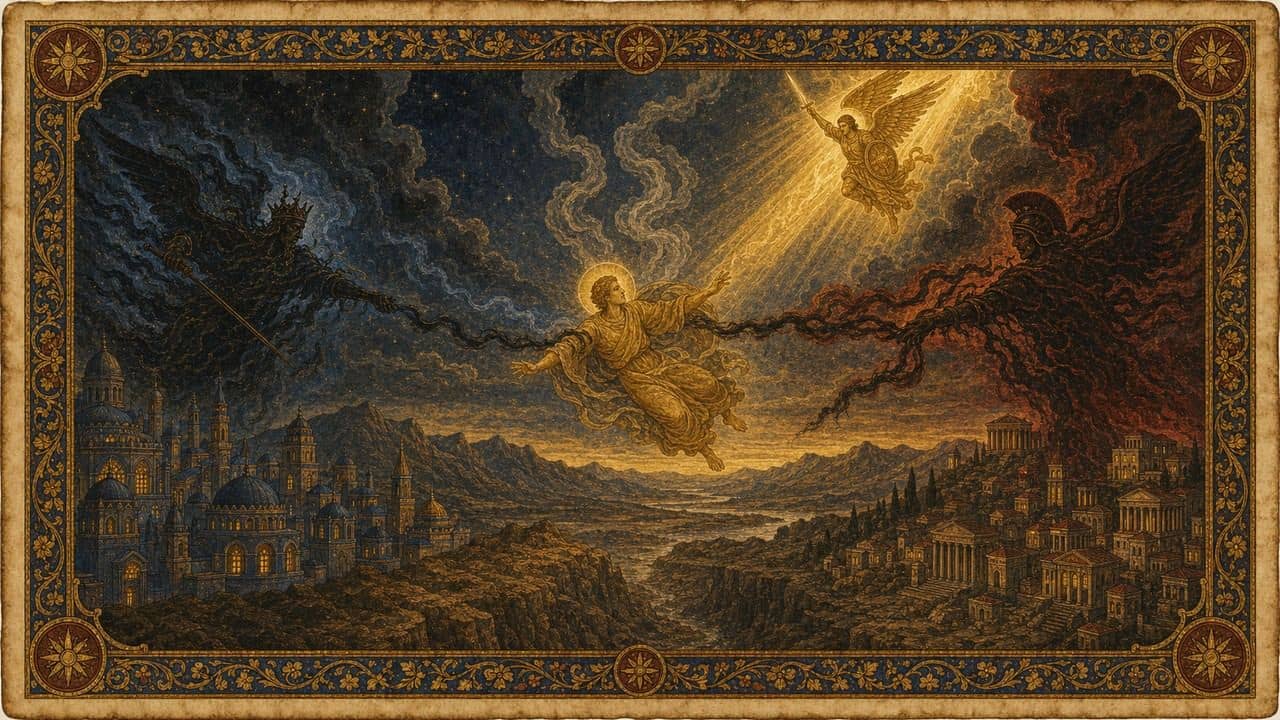
A name spoken from the tombs. An angel over the abyss. Princes opposing a messenger. The sources describe different kinds of figures, and their words matter: begin with what each passage actually calls them.
10 entries, with quotations and source passages. The adversary’s titles have their own record in the order →
01
Spirits in encounters
Tobit, the Gospels, and Acts describe spirits being driven out or bound. A personal name, a collective answer, and a description do different work.
Tobit names the spirit and tells how Raphael binds him.
“because that she had been given to seven husbands, and Asmodaeus the evil spirit killed them, before they had lain with her.”— Tobit 3:8
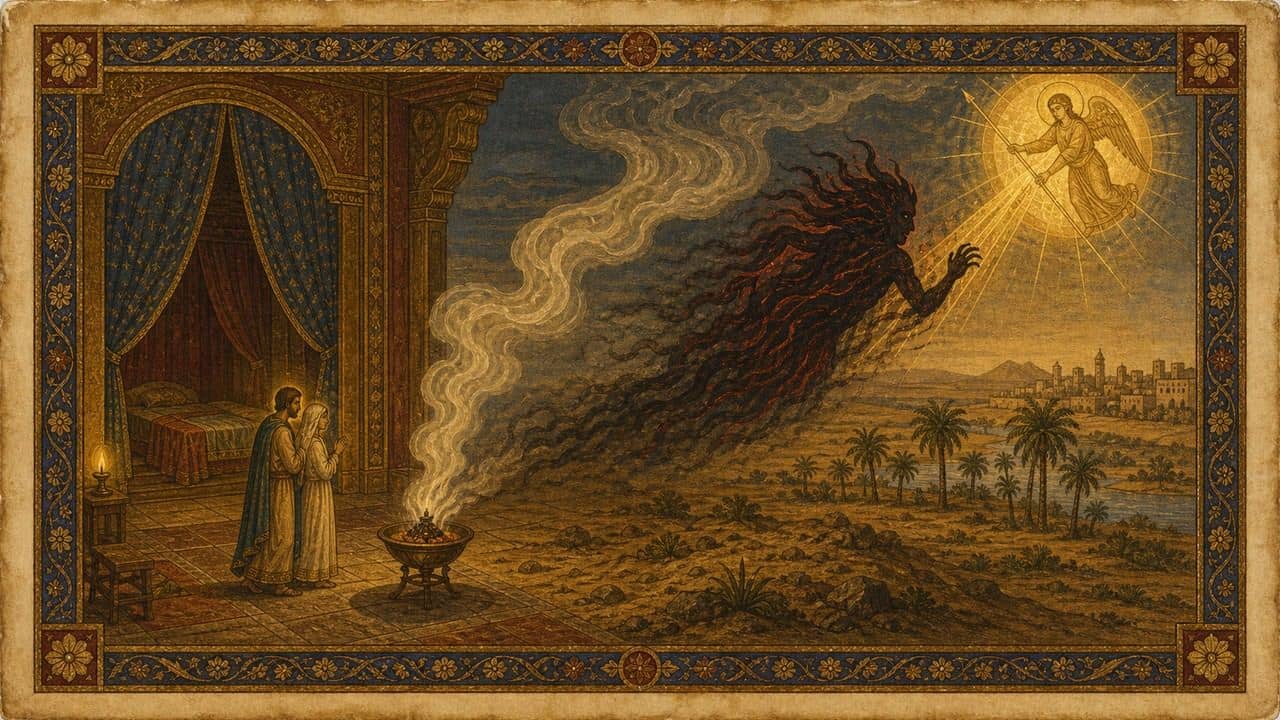
Interpretive illustration · Asmodaeus
The evil spirit who killed each of Sarah's seven husbands on their wedding night, before the marriage could be consummated; driven off by the smoke of a fish's heart and liver burned at 's instruction, he fled to the uppermost parts of Egypt, where the angel bound him.
Called simply "the evil spirit"/"the demon" in Tobit; traditionally linked to the Avestan Aeshma daeva ("demon of wrath"), though the book itself gives no etymology.
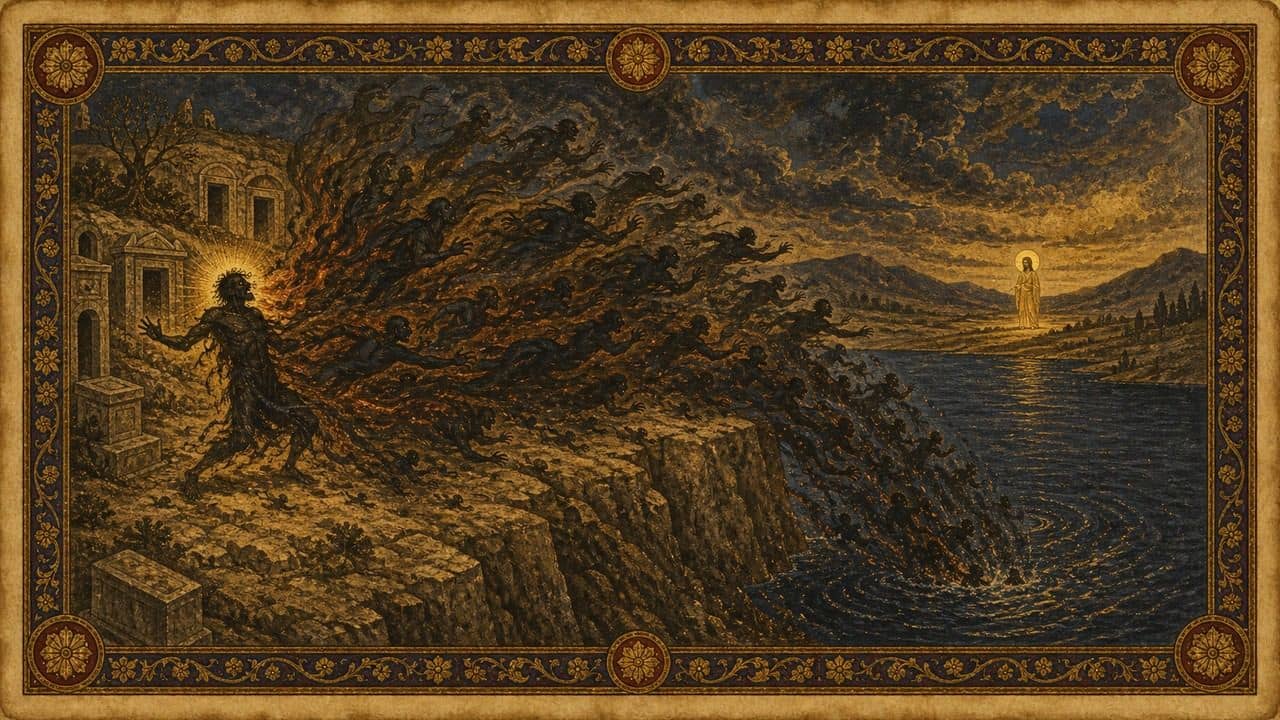
Possessed a man who lived among the tombs and could not be restrained even with chains; asked his name, he answered "My name is Legion, for we are many," and begged Jesus not to send them into the abyss — they entered a herd of about two thousand pigs, which rushed down the bank into the sea and drowned.
A Roman legion normally numbered several thousand soldiers; in Mark 5 the collective name emphasizes multiplicity and force. Political readings involving Roman occupation and boar imagery are proposals, not settled context.
Acts describes a spirit of divination; the Greek wording is “a spirit of Python”.
“a certain girl having a spirit of divination met us, who brought her masters much gain by fortune telling.”— Acts 16:16
In Philippi a slave girl's spirit proclaims Paul and his companions servants of the Most High God for days on end — true words from an unwanted source — until Paul commands it out in Jesus' name, and her owners lose their income.
Greek πνεῦμα πύθωνα, a Python spirit. Python was the serpent of Delphi, and by the first century the word meant a soothsaying spirit; the WEB translates it “divination”.
An angel of the abyss, a ruler of demons, opposing princes, and Paul's name for the adversary. Read the title before deciding what kind of being it describes.
Revelation calls this figure an angel and king over the locusts.
“They have over them as king the angel of the abyss. His name in Hebrew is “”, but in Greek, he has the name “Apollyon”.”— Revelation 9:11
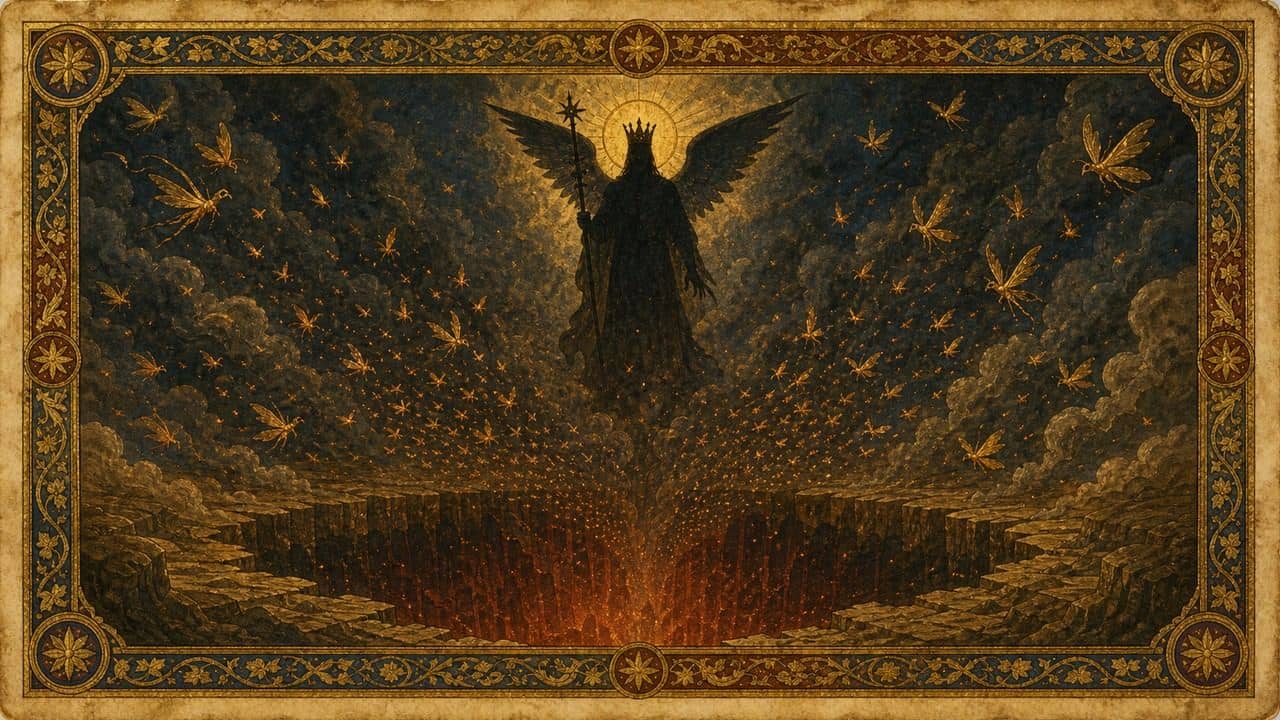
Interpretive illustration · Abaddon / Apollyon
The angel of the abyss, king over the locust-like creatures that rise from the smoke of the opened pit — creatures given power to torment for five months, but not to kill. His name in Hebrew is Abaddon; in Greek, Apollyon.
Hebrew "Abaddon" means destruction/ruin; Greek "Apollyon" means destroyer — the WEB text gives both names explicitly as translations of each other.
The name appears in the charge that Jesus casts out demons by their prince.
“By the prince of the demons he casts out the demons.”— Mark 3:22
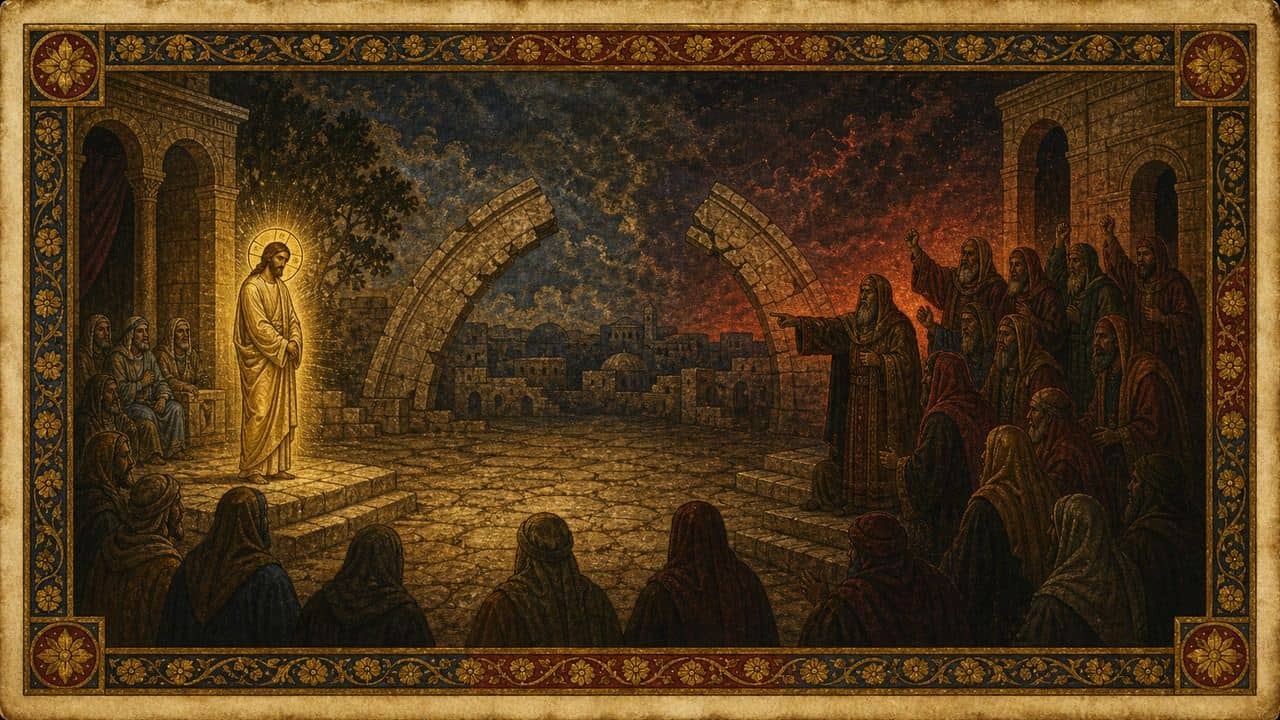
Interpretive illustration · Beelzebul
The name from Jerusalem threw at Jesus — "By the prince of the demons he casts out the demons" — and Jesus answered that a kingdom divided against itself cannot stand. The name traces to Zebub, the god of Ekron whom King Ahaziah's messengers went to consult — a distinct Philistine deity, not literally the Gospels' prince of the demons.
Beelzebul/Beelzebub is related to Baal-zebub of 2 Kings 1 and is used in the Gospels as a title for the ruler of demons. Proposed derivations from Ugaritic zbl bʿl and theories of deliberate satire remain disputed.
Daniel names opposing princes by their kingdoms, without identifying them as Satan.
“But the prince of the kingdom of Persia withstood me twenty-one days; but, behold, Michael, one of the chief princes, came to help me because I remained there with the kings of Persia.”— Daniel 10:13
Interpretive illustration · The Princes of Persia and Greece
The prince of the kingdom of Persia withstood the angelic messenger sent to Daniel for twenty-one days, until Michael, one of the chief princes, came to help; the messenger must return to that fight, with the prince of Greece to come next, and no one holds with him against them except Michael.
Territorial spirit-princes tied to the kingdoms of Persia and Greece, described as opposing God's messenger — never identified as Satan.
Paul's only use sets him against Christ in a run of opposites — righteousness and iniquity, light and darkness, Christ and Belial, believer and unbeliever.
Hebrew בְּלִיַּעַל (worthlessness, ruin). In sectarian Dead Sea Scrolls such as 1QM and 1QS, Belial is a personal leader associated with the lot and powers of darkness; Paul sets Belial against Christ in 2 Corinthians 6:15.
Leviticus leaves the term's meaning disputed; 1 Enoch names a fallen angel.
“Bind hand and foot, and cast him into the darkness: and make an opening in the desert, which is in Dûdâêl, and cast him therein.”— 1 Enoch 10:4
On the Day of one goat is offered to and the other, bearing the people's sins, is sent alive into the wilderness. In 1 , Azâzêl teaches men weapons and cosmetics, and Raphael is sent to bind him in the desert until the day of judgment.
Azazel occurs four times in Leviticus 16; its meaning is disputed. 1 Enoch depicts Azazel as a fallen Watcher bound in Dudael, while 4Q180 connects Azazel with the Watcher tradition.
1 Enoch names the leader of the Watchers and tells of his binding.
“Go, bind and his associates who have united themselves with women so as to have defiled themselves with them in all their uncleanness.”— 1 Enoch 10:11
Leader of the two hundred who swore together on Mount Hermon and took human wives. He fears he alone will pay for the sin, so he binds the others by oath; God then sends Michael to bind him and his associates beneath the hills until the judgment.
Read as “the name has seen”. Charles prints the leader's name two ways in one chapter — Semjâzâ in verse 3, Samîazâz in the roll of leaders in verse 7.
Jubilees names him chief of the surviving spirits who test mankind.
“Lord, Creator, let some of them remain before me, and let them harken to my voice, and do all that I shall say unto them”— Jubilees 10:8
Chief of the unclean spirits who negotiates with God after the flood: when Noah prays for the destructive spirits to be bound, Mastema pleads that a tenth part remain before him to execute his will on the corrupt sons of men, while nine parts descend into the place of condemnation.
Hebrew מַשְׂטֵמָה (Mastemah), meaning hostility, animosity, or enmity. Jubilees portrays Mastema as the prince of the spirits who intercedes to retain ten percent of the disembodied spirits under his command to test mankind.